
Protect your faith from social pressure
“You do not allow society to define you.”
Because Islam will again feel like a stranger in a culture that normalizes values contrary to Islamic guidance, Muslims must protect their faith and descendants through firm boundaries, sincere prayer, education, and open communication.
The khutbah in 6 steps
- Connects lingering Ramadan lessons to a hadith that Islam began as a stranger, will return as a stranger, and promises glad tidings to strangers.
- Illustrates cultural pressure through riba, non-alcoholic drinks, abortion, interfaith marriage, and changing views of marriage and sexuality.
- Urges Muslims to define boundaries and remain firm without hatred or violence toward people with different values.
- Uses Quranic reminders about humanity’s loss and the danger of following the majority to challenge social conformity.
- Proposes sincere dua for descendants’ faith, stronger Islamic-school curricula, and direct communication about difficult topics.
- Closes with prayers for families, masajid, the sick, the deceased, and acceptance of Ramadan worship.
In the khateeb's words
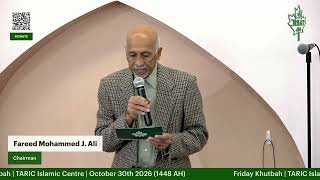
“Islam started As a stranger Flourished Will return as stranger And good news To the stranger That's what the Prophet Sallallahu Alaihi Wasallam Want his ummah to be”
“You got to believe that your progeny is in danger. That they are going to be lost. That Allah Ziyal Hadi. It is the nur of Allah that will keep them away from darkness.”
“You do not allow society to define you. And it takes strength to do that. If you don't instill that strength, that confidence, like my little brother sitting here.”
“You don't tell the child, shut up and listen and just do what I asked you to do. No, that doesn't work. Right? We got to talk.”
For the dinner table
The khateeb taught that Islam began as something strange and that practicing it faithfully can sometimes make Muslims feel different again. He encouraged us not to follow the majority automatically, but to understand our faith and draw thoughtful boundaries. He also emphasized that firmness does not require hatred or mistreatment, illustrating this by describing the duty to protect another person’s safety without compromising one’s beliefs. To help future generations remain strong, he called for sincere du'a, better Islamic education, and honest conversations at home and in our schools. His message was that children need knowledge, confidence, communication, and trust in Allah so they can be proud Muslims amid social pressure.
- When have you felt different because you were trying to do what you believed was right?
- What is one question about Islam that you would like our family to discuss openly?
- How can we be kind to people while still keeping our own values and boundaries?
More on Youth & education
 Muhammadi Masjid · Elmont, NY · Sep 25, 2026Parents must teach Islam at home“You have to save yourself and then you have to save your family from the fire of Jahannam.”
It starts at home by presenting the real role model for our children.29:05TARIC · Downsview, ON · Oct 31, 2026Parents shape their children's faith
 ICOPS · Lynnwood, WA · Oct 17, 2026Parents must teach children Islam