
True dignity comes from faith
“Ultimately, the measure of our success, of course, is not how the world perceives us, rather it is how Allah subhanahu wa ta'ala perceives us.”
True Muslim dignity comes from faith and taqwa, and must be expressed through steadfast principles, good character, and honest, compassionate conduct in everyday American life.
The khutbah in 6 steps
- Uses Muslim political representation in America to introduce questions of Muslim identity and confidence.
- Defines izzah as honor, dignity, and strength rooted in faith rather than wealth, status, or power.
- Uses Umar ibn al-Khattab’s humility to show that true dignity rejects performative prestige and arrogance.
- Connects Muslim identity with the Prophet’s steadfast principles, good character, and care for others.
- Challenges listeners to practice Islam openly and remain steadfast in prayer and principles when inconvenient.
- Concludes that taqwa, not worldly distinction, determines honor before Allah.
In the khateeb's words
“But what dignity and honor really is, is it's knowing who you are and where you come from. And if you're comfortable in that.”
“And Izzah is deeply rooted in this submission to Allah subhanahu wa ta'ala. And Kibr, of course, is deeply rooted in a submission to yourself, in a submission to your nafs.”
“Ultimately, the measure of our success, of course, is not how the world perceives us, rather it is how Allah subhanahu wa ta'ala perceives us.”
For the dinner table
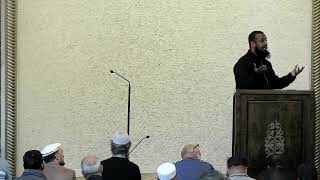
Today the khateeb talked about being proud and confident as Muslims in America. He started with the election of Abdul El-Sayed, the first Muslim senator-elect, and said that representation matters, especially for young Muslims. He also made clear that the khutbah was not about politics. He explained that real honor, called Izzah, comes from Allah and from our iman, not from money, power or job titles, and that real Izzah makes us more humble, not arrogant. He told the story of Umar (ra), who led his own camel through the water barefoot because he knew Allah had honored us through Islam. The main message is that each of us represents Islam through honesty, kindness and steadfastness, especially when it is inconvenient, because what counts in the end is how Allah sees us.
- When is it easy to act like a Muslim, and when is it harder for you?
- Why do you think Umar (ra), the leader of all the Muslims, chose to walk through the water himself?
- What is one kind or honest thing you could do this week that shows people what a Muslim is like?
More like this
Do not choose ten habits today then abandon them tomorrow.9:50VRIC · Valley Ranch, TX · Nov 20, 2026Small deeds can change your character
 IOK · Diamond Bar, CA · Nov 14, 2026Hardship does not mean Allah abandoned you“What He did promise is that what is to come will be better for you.”Patience & trials
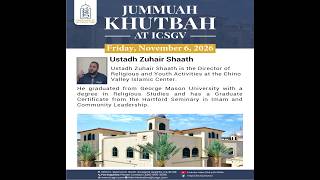 ICSGV · Rowland Heights, CA · Nov 7, 2026Gentleness reveals true character under stress“When things are going bad, actually, that's when true character often finds its way out.”

First you have to repent, repent to Allah, Subhanahu wa ta'ala, because you caused major bad deeds.19:38Masjid Al-Barakah · Vaughan, ON · Nov 21, 2026Guard your speech from backbiting and slander
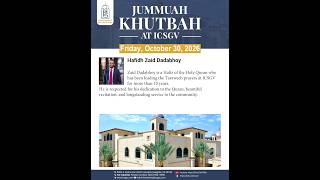 ICSGV · Rowland Heights, CA · Oct 31, 2026Hardship is not proof Allah has abandoned us“Look backward with gratitude, look forward with hope, and look around with compassion.”Qur'an & tafsir
Whatever I'm about to do, will it genuinely benefit me in this worldly life and, more importantly, in my hereafter?12:09ICN-BM · Bellevue, TN · Nov 21, 2026Trust Allah while taking useful action