
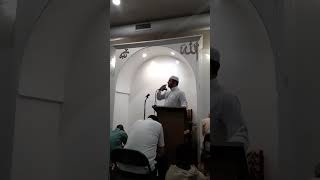
Youth & educationFrom the masjid's own video, Jun 20, 2026.
Use your youth before it passes
“You will never get this exact day back.”
In one sentence
Muslim youth should treat their limited, high-energy years as an amanah by protecting faith, disciplining time, and investing it in worship, learning, service, and lasting good.
The khutbah in 5 steps
- The khutbah opens by asking young people how they are spending their energy, freedom, and youth.
- The hadith of the seven shaded people establishes the special virtue of a youth raised in worship.
- Modern social pressure, friend groups, group chats, and cultural norms, is compared to the cave faced by earlier believers.
- Four actions are recommended: guard time, fill daily gaps, set boundaries around screens, and invest time in worship, learning, service, and family.
- The khutbah closes by urging listeners to use their remaining youth and summer intentionally.
Try this week
Treat time as a trust and track where it goes.
Use the spaces between prayers for Quran, dhikr, or focused beneficial work.
Set boundaries around scrolling, Reels, and TikTok rather than allowing screens to consume free time.
Invest time in learning skills, memorizing Quran, helping at the masjid, being present for family, and building something lasting.
Pray on time, learn Quran, and practice dhikr.
Quotes
In the khateeb's words
“The worship of a young person is more beloved to Allah than that of an old man”
“Every generation has its own cave For them it was a literal mountain But for us it may be a group chat”
“Most of us could not tell you honestly where the last three or four hours of our day went”
“You will never get this exact day back Not this juma'ah Not this youth Not this version of yourself With this much energy”
Talk about it at home
For the dinner table
The khutbah reminds us that youth is a special gift and a time when worship and good choices can shape an entire life. The speaker encourages us to notice where our hours are going, especially when screens quietly consume them. We can protect our time by praying on schedule, using small gaps for Quran or dhikr, and setting healthy boundaries. We should also invest our time in learning, serving others, caring for family, and building something that lasts.
- Where does your time go when you are not paying attention?
- What is one useful thing you could do during a gap between prayers?
- What screen boundary would help you use your time better this week?
Keep listening
More on Youth & education
 Muhammadi Masjid · Elmont, NY · Sep 25, 2026Parents must teach Islam at home“You have to save yourself and then you have to save your family from the fire of Jahannam.”

It starts at home by presenting the real role model for our children.29:05TARIC · Downsview, ON · Oct 31, 2026Parents shape their children's faith
 ICOPS · Lynnwood, WA · Oct 17, 2026Parents must teach children Islam