
Turn to Allah when overwhelmed
“Allah has given us the reset button.”
Maintaining spiritual and emotional sanity requires turning to Allah, using Quranic guidance and prayer to reset the mind, resist distractions, and remain steady through hardship.
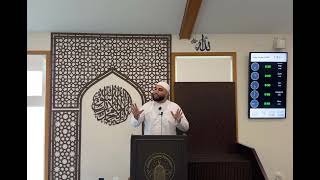
The khutbah in 6 steps
- Defines taqwa and sanity as inward awareness, rationality, and emotional balance.
- Uses Surah al-Fatiha as a daily spiritual reset and guide to reliance on Allah.
- Explains sensory overload and recommends stepping away from social media, news, and distractions.
- Draws comfort from Surah al-Duha, al-Inshirah, al-Falaq, al-Nas, and al-Rahman.
- Encourages quiet nighttime prayer, especially two additional rakahs, to surrender anxiety to Allah.
- Closes with reminders about continued effort, community announcements, zakat, and prayers for the sick and deceased.
In the khateeb's words
“So what you have to do, you have to unplug everything and find out, well, what is it that is short-circuiting up here.”
“Allah has given us the reset button. All we have to do is reset, reset this, reset your thinking, reset your behavior.”
“The Quran is directing, not necessarily to the outside world, but the inside world of yourself.”
“Don't just think, well, I got this one time and that's it. It's going to continue. No, you still got the labor.”
For the dinner table
The khateeb taught that keeping our sanity begins by turning back to Allah and noticing what is happening inside us. He presented Surah al-Fatiha as a daily reset that opens the mind, strengthens reliance on Allah, and asks for the straight path. He encouraged us to reduce sensory overload, step away from constant news and social media, and use quiet prayer, especially two extra rakahs at night, to bring worries before Allah. He reminded us that hardship can come with relief, but relief does not end our responsibility to keep worshipping and working. The family takeaway is to seek guidance, protect our attention, and respond to stress with prayer, reflection, and steady action.
- When do you feel most able to think and pray quietly?
- What good habit can you keep going even when life becomes easier?
More on Health & wellbeing

If a brother comes to us and admits that they have a gambling problem, do not look down upon them or cast them out.31:21Brand Lane Islamic Center · Stafford, TX · Jul 18, 2026Gambling apps can destroy Muslim families
Seeking a therapist, a psychiatrist, a counselor, or a crisis service doesn't contradict tawakkul.4:19Masjid Subhan · Scarborough, ON · Oct 3, 2026Protect life with hope and support
 IAGD · Rochester Hills, MI · Sep 11, 2026Protect the mind from addiction“It's a gift from Allah subhanahu wa ta'ala and we are also told not only to use that gift but also to protect that gift.”