
The Quran turns knowledge into transformation
“Information is not the same as transformation.”
In an age overflowing with information, the Quran calls believers to transformation, beginning with submitting to Allah, knowing Him through His names, and embodying those qualities in daily life.
The khutbah in 6 steps
- Reflects on Muslim visibility in American public life and the meaning of openly carrying Muslim identity after 9/11.
- Frames the problem of unprecedented information coexisting with widespread uncertainty about purpose.
- Contrasts information with the Quran's transformative mission.
- Urges believers to know Allah through His 99 names and cites al-Ghazali's mirror analogy.
- Explains Allah's names as road signs and human beings as representatives of Allah.
- Contrasts Quranic submission with secular self-help centered on the self, then applies Surah al-Jum'a.
In the khateeb's words
“Information is not the same as transformation. And ultimately, the book of Allah, the Kalam of Allah came down for transformation, to change us.”
“The perfection of the servant lies in being a mirror of his Lord, not in form, but in meaning.”
“Allah's names, according to Imam al-Ghazali, rahimahullah, are exactly like road signs.”
For the dinner table
The khateeb encouraged us to feel confident in our Muslim identity while showing understanding toward those who have faced fear or discrimination. His main reminder was that having lots of information does not automatically give us purpose or change our lives. He described the Quran as a book of transformation, calling us to live what we learn. He encouraged us to get to know Allah through His beautiful names and let that knowledge guide our actions, including treating people with mercy. He also reminded us that growth begins with submission to Allah, giving our efforts a purpose beyond ourselves.
- What helps you feel comfortable sharing your Muslim identity with others?
- What is one thing you learned recently that you could put into practice this week?
- How could we show more mercy to one another at home tomorrow?
The masjid
More on Seeking knowledge
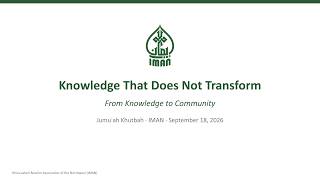 IMAN Center · Kirkland, WA · Sep 19, 2026Knowledge matters only when it changes us“Sometimes the problem is knowledge without action.”
 Daar-Ul-Islam · Ballwin, MO · Oct 3, 2026The first revelation calls us to learn and serve“Before any type of great transformation occurs outwardly, there must be deep reflection inwardly.”
 CCIL-KBW · Laval, QC · Sep 26, 2026Protect your heart from information overload“Faire confiance à Allah ne signifie pas rester sans rien faire.”