
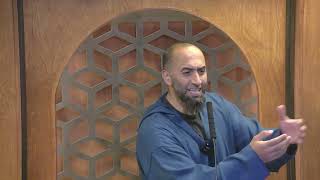
General remindersFrom the masjid's own video, May 30, 2026.
Use your time before it is gone
“What did you do with your life?”
In one sentence
Because time, health, and youth are blessings for which Muslims will be accountable, believers should protect obligatory worship, set specific goals, use small consistent intervals, and remove distractions to serve themselves and the Ummah.
The khutbah in 6 steps
- Interprets limited lifespan and the Day of Judgment's questions about life, youth, wealth, and knowledge.
- Explains that health and free time are often squandered blessings.
- Urges specific goals, prioritizing obligatory worship, and serving the Ummah through one's abilities or career.
- Illustrates how scholars used tiny intervals and warns against delay and procrastination.
- Recommends sincerity, early mornings, daily Qur'an reading, and removing social-media distractions.
- Closes with a prayer for beneficial use of time and service to the Ummah.
Try this week
Write a specific, achievable goal for the available time.
Prioritize the five daily prayers and other individual obligations before optional deeds.
Choose a concrete way to serve the Ummah through skills, work, donations, or the masjid.
Use five or ten minutes daily for a consistent practice, such as memorizing one Qur'an line.
Use the time after Fajr for focused work.
Read the Qur'an every day for 15 to 20 minutes or another consistent portion.
Delete social-media apps from the phone and access accounts only occasionally on a computer.
Quotes
In the khateeb's words
“Allah will ask you, what did you do with your life? You had 30, 40, 50, 70 years in this world. What did you do when you were alive?”
“Wealth can come back to you. If you give some money in sadaqah, maybe Allah will replace it for you. But when it comes to your time, if you wasted your time, that minute will never come back to you.”
Keep listening
More on General reminders

No matter how many steps in your life you took away from Allah, it only ever takes one step to come back.17:46Collins Musallah · Richardson, TX · Oct 30, 2026Allah's guidance protects every part of life

I want to give half an hour to my children just to be with them to be present.29:02Masjid Al-Noor · Brookfield, WI · Sep 3, 2026Use your time before it is gone
We're not just searching for productivity and efficiency, but more importantly, we're searching for barakah.6:58MCF · Folsom, CA · Oct 24, 2026True productivity comes from seeking barakah