
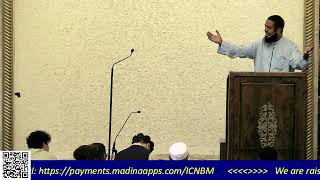
Death & the hereafterFrom the masjid's own video, Sep 3, 2025.
Fear the Hereafter more than worldly loss
In one sentence
Fear of the Hereafter should outweigh worldly fears and drive Muslims to protect their prayers, attend the masjid, repent promptly, and avoid mistaking prosperity for divine approval.
The khutbah in 7 steps
- Contrasts ordinary fears of poverty and financial insecurity with Qur'anic warnings about the Hereafter.
- Describes the universal terror of Resurrection through vivid Qur'anic scenes.
- Uses the prophets' and angels' fear to show the seriousness of the Day of Judgment.
- Calls listeners to let that fear motivate Fajr, Isha, and congregational prayer.
- Warns that deliberately neglecting salah is far more serious than accidentally missing it, which requires immediate prayer and repentance.
- Urges immediate tawbah after sin and warns that abundant wealth can be a deceptive reprieve.
- Closes with supplications, praise, and an exhortation to taqwa.
Try this week
Set an alarm and make Fajr on time.
Attend Fajr and Isha in the masjid when able.
If a prayer is accidentally missed, pray it immediately upon remembering it.
Repent and seek Allah’s forgiveness immediately after committing a sin.
Command and encourage family members to maintain salah.
Quotes
In the khateeb's words
“The only thing that Allah is telling us that the Qur'an is full of it, almost everywhere in the Qur'an is the fear of the things that will happen in the next life.”
“My brothers, this kind of fear should be a driving force for us. To get up in the morning and make sure I have my alarm on, so I can do my salat, my fajr salat on time.”
“If you see someone recklessly committing sins, and the worst of which we talked about is, you know, a man neglecting salah and not seeking forgiveness. Yet Allah is showering him with risk, abundant of risk.”
Talk about it at home
For the dinner table
Today’s khutbah reminded us that the Qur’an focuses our deepest concern on the Day of Judgment, not only on worldly worries. That fear should motivate us to pray on time, especially Fajr and Isha, and to attend the masjid when we can. If we sin, we should turn back to Allah quickly and ask for forgiveness. The speaker also warned that wealth and comfort are not automatically signs of Allah’s approval. Our family can respond by making salah, repentance, and preparation for the Hereafter part of our daily routine.
- What helps you remember Fajr when you are tired?
- How can our family make salah and repentance easier this week?
- Why might having more money not always mean we are doing well spiritually?
Keep listening
More on Death & the hereafter
Fit your schedule around your prayer.18:56ICN-BM · Bellevue, TN · Oct 17, 2026Use your limited time before judgment

The currency in the hereafter is your good deeds.15:14IMAAM Center · Silver Spring, MD · Oct 17, 2026Protect your good deeds by righting wrongs

The truth does not give us permission to spread unverified claims.25:09Masumeen · Brampton, ON · Oct 17, 2026Why the afterlife makes justice necessary