
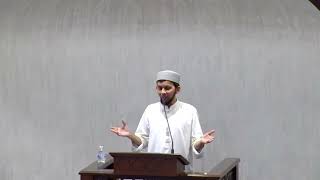
The ummah & current eventsFrom the masjid's own video, Mar 13, 2022.
Imams deserve fair treatment and support
ICNE · Khalid Nasr
In one sentence
Mosques must honor imams as qualified religious leaders, evaluate them fairly, support them humanely, and resolve disagreements with knowledge and justice.
The khutbah in 6 steps
- Opens with praise, prayer, and a call to God-consciousness.
- Argues that imams should be appointed according to knowledge and qualifications.
- Criticizes opaque mosque boards for humiliating or arbitrarily dismissing imams.
- Uses Umar ibn Khattab's inquiry into the governor of Hims to illustrate fair judgment and compassion.
- Applies the lesson to imam compensation, workload, worship, and mosque leadership conflicts.
- Closes with supplication, adhan, prayer, and Quran recitation.
Try this week
Choose and evaluate imams based on knowledge and qualifications.
Hear an imam's explanation before making disciplinary decisions.
Treat imams with dignity and avoid humiliating them.
Provide fair compensation and realistic expectations for imam service.
Reserve time for personal worship and the hereafter.
Quotes
In the khateeb's words
“what kind of humiliation you are doing to the imam who lead the prayer who is leading you who is giving preaching you and leading you in Ramadan”
“he said I divided the day and night between me between them and Allah the day for them and the night for Allah subhanahu wa ta'ala”
“exhaust yourself doing helping this and that and you go at night you don't do two raka'at or four raka'at you have to have your share also for the hereafter”
Talk about it at home
For the dinner table
The khutbah asks us to treat the imam as a trusted religious leader. It says mosque leaders should choose and evaluate imams by knowledge and qualifications, not status, wealth, or personal agendas. When disagreements arise, people should hear the imam's side and act fairly instead of humiliating him. The story of the governor of Hims reminds us that leaders may have private burdens and need understanding. At the same time, people who serve the community should protect a share of their time for worship and the hereafter.
- How can we show respect to the people who serve our mosque?
- What should we do when we disagree with a community leader?
- How can we make time for helping others and worship?
Where it was given
The masjid
Keep listening
More on the ummah & current events
Islam belongs to all of humanity.16:15FIC · Swartz Creek, MI · Oct 10, 2026Dawah must serve all of humanity
 EPIC · Plano, TX · Aug 3, 2026The ummah must serve humanity“We have to engage the greater society and we have to better the greater society.”
 18:19ICRR · Round Rock, TX · Aug 1, 2026Liberation depends on the next generation“The success of a project is not dependent on the physical completion of it, but it's dependent on if the next generation inherits your legacy or not.”