
Why caring relationships are a trust
“The most important thing after my iman is the relationships that I build.”
Islamic relationships are a trust requiring balanced love, fairness, patience, and active care for family, relatives, neighbors, and the wider community rather than individualistic self-interest.
The khutbah in 6 steps
- Frames noble character and taqwa as foundations for relationships.
- Explains that strong family members combine principled firmness outside with playfulness and ease at home.
- Uses equal treatment of children and Abdullah ibn Umar’s service to his father’s friends to teach fairness and honoring kin.
- Extends relational duties to children, spouses, neighbors, and in-laws through Luqman, the Prophet, Ali, and Fatima.
- Warns against utilitarian, individualistic relationships and urges patience, greetings, participation, and noticing absent community members.
- Closes by presenting caring relationships as a source of iman, happiness, and shared journey toward Allah, followed by prayers.
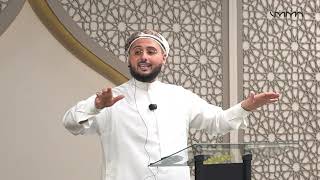
In the khateeb's words
“The sign of a successful family member is that person who's like a lion outside and not in the pejorative, who's strong and firm outside, but at home he's as playful as a child.”
“And Islam does not believe in this individualistic society where it's me, myself, and I. Or even the nuclear family where it's only me and my wife and my children.”
“Respecting the neighbor doesn't mean I have to go out of my way in a point where I'm in discomfort. No. It means I shouldn't be a source of discomfort for other people.”
“the most important thing after my iman is the relationships that I build that not only get me closer to Allah subhanahu wa ta'ala but allow me to live a satisfactory and happy lifestyle”
For the dinner table
Islam teaches that our relationships are responsibilities entrusted to us, not just sources of convenience. At home, we should combine clear principles with affection, playfulness, fairness, and willingness to hear one another’s difficulties. We should honor parents by caring for the people connected to them, treat children equally, respect neighbors, and keep family ties. Even when community life is difficult, patience and participation bring iman, happiness, and support. The goal is to repair strained families and walk together toward Allah.
- What is one way we can make home feel more playful and welcoming this week?
- Which relative, neighbor, or community member could we check on?
- How can we balance personal hobbies with time for family and community?
More on Family & marriage

Don't let a moment of disagreement turn into conflict where years of good are forgotten like that.14:45IAR Atwater · Southwest Raleigh, NC · Oct 31, 2026Protect relationships when disagreements arise
 EPIC · Plano, TX · Oct 30, 2026Honor your mother while you still can“Call sometimes just because you want to hear her voice.”
We cannot have disrespectful parents disrespecting each other in the presence of their kids.22:41UMMA · Southfield, MI · Sep 19, 2026Faith shows in how we treat family