What Jesus did when he met sin
Mark 2:5-10, WEB
Jesus, seeing their faith, said to the paralytic, “Son, your sins are forgiven you.” But there were some of the scribes sitting there and reasoning in their hearts, “Why does this man speak blasphemies like that? Who can forgive sins but God alone?” … “But that you may know that the Son of Man has authority on earth to forgive sins”, he said to the paralytic, …
read the chapter ↗
Jesus declares the paralytic forgiven at once. No one brings an offering, and he demands none. Then he heals the man, validating, as Christians rightly stress, the Son of Man's authority to forgive. Mark's scribes state the premise both faiths share: God forgives. And Mark's Jesus exercises that authority on earth. Readers dispute what that authority is: God delegating it (the Islamic reading, and one Christian reading of “given” authority), or God exercising His own prerogative in person (the christological reading). Mark's own words are “authority on earth,” and both readings are on the table.
When Jesus taught his followers what receiving that forgiveness involves, the terms he named were repentance and reciprocity: “For if you forgive men their trespasses, your heavenly Father will also forgive you. But if you don't forgive men their trespasses, neither will your Father forgive your trespasses” (Matthew 6:14-15, WEB ↗), attached to the very prayer he taught, which asks the Father directly: “forgive us our debts.” A Christian reads these as the conditions of receiving a forgiveness grounded elsewhere, in the cross; the texts themselves state the conditions and, in these scenes, no ground beyond God's own mercy. That difference, condition versus ground, is the exact point at issue on this page; the sections below examine it rather than assume it.
The Hebrew Bible's two strands, both quoted
Scripture the atonement debate is built on contains both a sacrificial system and forgiveness without sacrifice. Here are both.
The sacrificial strand
But he was pierced for our transgressions. He was crushed for our iniquities. The punishment that brought our peace was on him; and by his wounds we are healed. … Yahweh has laid on him the iniquity of us all.
Isaiah 53:5-6, WEB ↗: the servant song Christians read of Christ; Jewish tradition has read the servant as Israel. Torah's offerings gave sacrifice a real atoning role, and Psalm 51 itself closes by anticipating restored offerings (51:19). This strand is real.
Individual responsibility across generations
The soul who sins, he shall die. The son shall not bear the iniquity of the father, neither shall the father bear the iniquity of the son. The righteousness of the righteous shall be on him, and the wickedness of the wicked shall be on him.
Ezekiel 18:20, WEB ↗: addressed to inherited guilt across generations; it does not by itself adjudicate voluntary representation, which the argument below takes up on its own terms.
Mercy ranked above sacrifice
For I desire mercy, and not sacrifice; and the knowledge of God more than burnt offerings.
Hosea 6:6, WEB ↗: a verse Jesus quoted twice in Matthew. Psalm 51, after David's gravest sin: “The sacrifices of God are a broken spirit” (51:17). Contrition is indispensable, ritual insufficient without it.
Forgiveness on repentance alone, in the scene
God saw their works, that they turned from their evil way. God relented of the disaster which he said he would do to them, and he didn't do it.
Jonah 3:10, WEB ↗: Nineveh's announced judgment averted when the city turned. And the law itself accepted a flour offering (no blood) from the poor as a sin offering (Leviticus 5:11-13): within Torah, blood is not an exceptionless requirement.
The strongest Christian case
Two texts state the justice-and-blood case compactly, and they are quoted here without trimming. Paul, Romans 3:23-26: “for all have sinned, and fall short of the glory of God; being justified freely by his grace through the redemption that is in Christ Jesus, whom God sent to be an atoning sacrifice through faith in his blood, for a demonstration of his righteousness through the passing over of prior sins, in God's forbearance; to demonstrate his righteousness at this present time, that he might himself be just and the justifier of him who has faith in Jesus” (WEB ↗). And Hebrews: “According to the law, nearly everything is cleansed with blood, and apart from shedding of blood there is no remission” (Hebrews 9:22, WEB ↗). Note what Paul's full sentence claims: God had been “passing over” sins in forbearance, and the cross demonstrates his righteousness: mercy and justice meeting in God's own self-gift. In the classical formulations (Catholic Catechism §§601-623 ↗), Christ is neither coerced nor an unrelated third party: the divine Son freely offers himself, representing the humanity he assumed: God bearing the cost of reconciliation himself.
Grant that case its actual premises before testing it: voluntariness and divine identity. A volunteer courtroom stranger is not the Christian claim, and refuting it refutes nothing. Voluntariness answers coercion. Divine identity answers the unrelated third party. What neither premise answers is the necessity claim itself: why a sacrificial death is required for forgiveness at all.
So put the necessity claim to the texts. David confessed adultery and murder; Nathan's recorded answer is “Yahweh also has put away your sin” (2 Samuel 12:13, WEB ↗), put away on confession, with no sacrifice in the sentence. Nineveh repented; God relented. The paralytic was forgiven with a word, before Jesus mentioned proof. The prodigal was embraced at the gate, mid-confession. David's own psalm states it as doctrine: “The sacrifices of God are a broken spirit.” And Leviticus itself accepts flour from the poor where blood is unaffordable. The scenes are quoted above.
If God put away David's sin at his confession, spared Nineveh on its repentance, forgave the paralytic with a word and the prodigal at the gate, where does either Testament show God telling a repentant person that repentance is not enough?
The Christian answer at its strongest concedes the scenes and moves the claim behind them: the cross is the ground of every one of those forgivenesses, retroactively; Romans 3's “passing over” of prior sins is read exactly that way. Take that answer seriously, because it is unfalsifiable from inside the scenes: a ground standing outside the story cannot be refuted by the story. But notice where the claim now lives. The scenes themselves never state that the cross grounds their forgiveness; the Christian reading of Romans and Hebrews supplies the ground behind them. Those letters do state a sacrificial ground, and their application to these earlier scenes is retroactive. And Paul's own verb is measured: the cross demonstrates God's righteousness (his theological reading of the event), and a demonstration is not a proof that repentance, restitution, and mercy form an incoherent alternative.
Hebrews 9:22 deserves the same precision. Its own sentence says “nearly everything,” and the flour offering shows blood was not exceptionless even within Torah, so the verse cannot serve as a slogan that God cannot forgive without blood. What Hebrews argues at full length is a covenantal rereading in which the sacrificial system prefigured a single self-offering. It does not deny repentance as the condition those scenes show; it adds the Christian claim that Christ's offering is their hidden ground: coherent within its premises, and a claim, not a demonstration.
Now the tally. When David confessed, God put away his sin. When Nineveh repented, God relented. When the paralytic's friends broke through the roof, Jesus forgave before anyone mentioned proof. When the son turned for home, the father ran. The scenes span both Testaments, and none presents a death as the stated ground of the forgiveness pronounced. Christians read one ground beneath all four: Romans and Hebrews state it; its application to these scenes is retroactive, a premise the scenes can neither confirm nor refute, and which they read complete without. Islam builds its doctrine on the strand the scenes state: “Do not lose hope in Allah's mercy, for Allah certainly forgives all sins” (Quran 39:53 ↗); “who forgives sins except Allah?” (3:135 ↗), the same premise Mark's scribes state. Repentance in Islam is not leniency: stop the wrong, restore what was taken, stand before the One who saw the deed with no self-excuse left. What it does not require is a victim.
The father who ran
“I will get up and go to my father, and will tell him, ‘Father, I have sinned against heaven and in your sight'… But while he was still far off, his father saw him and was moved with compassion, and ran, fell on his neck, and kissed him” (Luke 15:18-20). Christians and Muslims both recognize in this story the urgency of return and the generosity of divine mercy; they disagree about whether the cross is the ground of that welcome. Let the parable do what it was told to do: draw you toward repentance and hope in God. And weigh the doctrinal question with the texts above, not with this story alone.
The question, argued on camera
The written case above stands on its own. One recording follows, embedded whole: a lecture from Blogging Theology, a channel presented by Paul Williams, on whether Christianity as usually taught leaves room for forgiveness at all. Timestamps jump to each argument. What it adds to this page is a voice from inside Christian theology: the first two quotes are not Williams's own words but the Christian theologian John Hick's, read aloud from Hick's book The Metaphor of God Incarnate, and the charge is Hick's. Williams also reads Hick citing the New Testament scholar E. P. Sanders, who wrote that forgiving repentant sinners runs through nearly all the surviving Jewish writing of the period. The third quote is Williams's own comment on the parable of the returning son. Hick was one theologian and this is one Christian reading among several; the case Christians make in reply is quoted at its strongest above.
Williams reads Hick, then comments
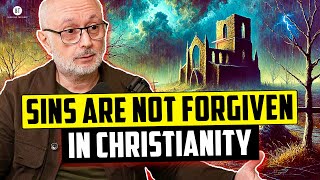 A lecture reading a Christian theologian's argument that forgiveness which has to be bought is not forgiveness, with the Gospel scenes read alongside it
 · Paul Williams (Blogging Theology) ↗
0:46 ↗ Williams reads the charge from the Christian theologian John Hick's book: that traditional accounts of salvation leave no room for divine forgiveness, because a forgiveness that has to be purchased is a debt settled rather than a debt forgiven.
“For a forgiveness that has to be bought by the bearing of a just punishment, or the giving of an adequate satisfaction, or the offering of a sufficient sacrifice, is not forgiveness.”
1:33 ↗ Reading on from Hick, Williams reaches Hick's claim about the prayer Jesus taught: its stated condition is that we forgive one another, and Hick says the text puts no go-between and no atoning death between the one praying and God.
“There is no suggestion of the need for a mediator between ourselves and God, or for an atoning death to enable God to forgive.”
4:43 ↗ After reading the parable of the returning son aloud, Williams gives his own comment on it: the father's welcome is immediate, and Williams says the story shows no sacrifice and no substitute standing between the son and his father.
“God forgives people directly, welcomes them with mercy and compassion when they turn to him.”
Continue at your pace
Questions people ask
How is sin forgiven in Islam?
By repentance, directly, with no intermediary and no sacrifice: sincere return to God (tawbah) before death, abandoning the wrong, restitution where a person was wronged, and asking forgiveness. “O My servants who have exceeded the limits against their souls! Do not lose hope in Allah's mercy, for Allah certainly forgives all sins” (Quran 39:53), read, classically, with the call to return in the verses that follow it. The Quran's account of Adam ends not with an inherited stain but with a lesson in returning: “Then Adam was inspired with words ˹of prayer˺ by his Lord, so He accepted his repentance” (2:37).
Do Muslims believe in original sin?
No. In the Quran, Adam sinned, repented, and was forgiven (2:37), and no descendant carries his guilt: “No soul burdened with sin will bear the burden of another” (35:18). Every person is answerable for their own record, which is also the principle Ezekiel states for moral responsibility across generations: “The soul who sins, he shall die. The son shall not bear the iniquity of the father” (Ezekiel 18:20). On the Islamic account, what humans inherit from Adam is not guilt but the pattern, falling, and the open door back.
Didn't Jesus say his blood was shed for the forgiveness of sins?
Matthew's Last Supper account records Jesus saying his blood is “poured out for many for the remission of sins” (Matthew 26:28), Mark records “a ransom for many” (Mark 10:45), and the New Testament letters build the theology of atonement on the cross. This page quotes that case at its strongest before examining it. What it sets alongside are Jesus's earlier practice and teaching, forgiving sins during his ministry (Mark 2:5), naming repentance and forgiving others as what receiving God's forgiveness involves (Matthew 6:14-15), and narrating the prodigal son's father running to forgive, with no sacrifice in the story told (Luke 15).
Is anything unforgivable?
Each scripture gives a prominent warning about a form of final resistance to God. Jesus: “every sin and blasphemy will be forgiven men, but the blasphemy against the Spirit will not be forgiven” (Matthew 12:31), a saying Christians have interpreted variously, alongside other severe warnings. The Quran: “Allah does not forgive associating others with Him ˹in worship˺, but forgives anything else of whoever He wills” (4:48), which classical scholarship reads of a person who dies unrepentant in it, since 39:53 promises that sincere repentance reaches every sin. The parallel is real but should not be flattened into an exact equation; what both traditions place beyond forgiveness is not a deed against people but a closing of the self against God, carried to the end.
Bible quotations are World English Bible; Quran renderings are Dr. Mustafa Khattab's The Clear Quran, each linked to its source. If a quotation or attribution is inaccurate, send a correction.