
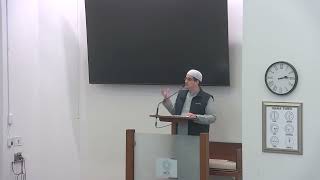
The Prophets & seerahFrom the masjid's own video, Sep 12, 2025.
Follow the Prophet through hardship
“He complains to Allah, not about Allah, but about himself.”
The khutbah in 6 steps
- Introduces prophetic resilience as a response to personal and global suffering.
- Uses the Ta'if episode to show perseverance, wise da'wah, and clarity under persecution.
- Explains how the Prophet responded to grief, including the death of his son Ibrahim.
- Connects sabr, shukr, and hope in Allah to the believer's response to calamity.
- Calls listeners to examine their relationship with Allah and reform themselves.
- Closes by emphasizing the Prophet's mercy and the need to follow his example.
Try this week
Study the seerah to identify prophetic responses to personal and communal hardship.
During calamity, complain to Allah rather than blaming Allah or questioning His decree.
Respond to blessings with shukr and trials with sabr.
Examine your relationship with Allah and undertake personal reformation before criticizing others.
Do not turn a blind eye to oppression; speak up with wisdom.
Quotes
In the khateeb's words
“But he does not lose his clarity of sight. And he knows what he must do. He knows that his message must reach the four corners of this globe.”
“He complains to Allah, not about Allah, but about himself.”
“the mu'min does not start blaming. The mu'min does not complain, except to Allah subhanahu wa ta'ala.”
Talk about it at home
For the dinner table
The khutbah focused on the resilience of Prophet Muhammad during persecution, grief, and loss. At Ta'if, even while injured, he continued inviting people with wisdom and hoped that future generations would accept Islam. When his son Ibrahim died, he cried but taught that grief does not justify words displeasing to Allah. We are encouraged to respond to blessings with gratitude, trials with patience, and every hardship by checking our relationship with Allah. The practical call is to reform ourselves, avoid blaming others, and follow the Prophet's merciful example.
- What is one hardship you can bring to Allah in du'a this week?
- How can we show patience without pretending we are not sad?
- What is one part of our own life we should reform before pointing at someone else?
Where it was given
The masjid
Keep listening
More on the Prophets & seerah
 IOK · Diamond Bar, CA · Sep 19, 2026Learn the Prophet's life to love him“Love is something that grows through knowledge.”

Be mindful of Allah, and He will protect you.9:56Al-Sabereen · Harrisburg, PA · Oct 24, 2026Defend the Prophet by living his example
No one can walk for you.5:06MCC San Diego · Rancho Bernardo, CA · Oct 3, 2026Prophetic mercy meets people where they are