
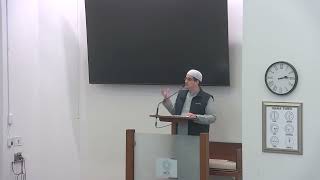
The Prophets & seerahFrom the masjid's own video, Aug 27, 2026.
Put worship and justice before lesser wants
“The Islamic theory of change is not only a positive one but also a peaceful one.”
The khutbah in 5 steps
- It recounts Abu Bakr’s attempted migration, his protection by Ibn al-Dughna, and the second migration after persecution intensified.
- It argues that Islam demands constructive action despite weakness and warns that passive good people can share in communal punishment.
- The Prophet’s method of change is described as peaceful, gradual, and collaborative, including alliances with people of other faiths.
- The khutbah applies prioritization to social, economic, judicial, and women’s rights, then distinguishes values from priorities.
- It closes by ranking worship, prayer, and honoring parents above work, money, sport, and other preferences.
Try this week
Study the Prophet’s seerah carefully so his example guides your conduct.
Take constructive action despite weakness instead of using weakness as an excuse.
Pursue change gradually rather than trying to correct everything overnight.
Build alliances and cooperate with Muslims and non-Muslims around justice and good.
List your values, choose your priorities, and check whether lesser interests have taken over.
Put salah first, attend Jumu'ah, and honor and care for parents.
Sources the khateeb cited
Quran 29:2-3Trials and persecution are described as an established test of sincere faith.
Quran 2:214Trials and persecution are described as an established test of sincere faith.
Sahih al-BukhariReports about Uthman’s two migrations and Abu Bakr’s experience support the account of migration to Abyssinia.
Quran 4:97The passage challenges believers who use weakness as an excuse for failing to act.
Quran 8:25The sermon warns that communal punishment can affect passive people and praises those who actively reform society.
Quran 11:117The sermon warns that communal punishment can affect passive people and praises those who actively reform society.
Quran 5:2Cooperation in righteousness is used to establish a peaceful theory of social change.
Quran 9:19Different good deeds are not equal, establishing the need for a hierarchy of priorities.
Quran 17:23-24Worshiping Allah and honoring parents are presented as the highest personal priorities.
Quotes
In the khateeb's words
“the part that Allah will punish us for if we didn't do it is the islah part”
“the Islamic theory of change is not only a positive one but also a peaceful one guided by the ayah”
“make sure they do not climb up to the top of your list of important things to do”
“I structure my life around Salat Salat first everything else is second”
Keep listening
More on the Prophets & seerah
 IOK · Diamond Bar, CA · Sep 19, 2026Learn the Prophet's life to love him“Love is something that grows through knowledge.”

Be mindful of Allah, and He will protect you.9:56Al-Sabereen · Harrisburg, PA · Oct 24, 2026Defend the Prophet by living his example
No one can walk for you.5:06MCC San Diego · Rancho Bernardo, CA · Oct 3, 2026Prophetic mercy meets people where they are