John 17: “the only true God”
On the last night, John's Gospel gives Jesus a full chapter of prayer: for himself, for his disciples, and for everyone who would believe after them. It contains John 17:3, a central text in this disagreement (Jesus addressing his Father as “the only true God”), and verse 5, the chapter's strongest counter-text.
The prayer
John 17:1-11
1Jesus said these things, then lifting up his eyes to heaven, he said, “Father, the time has come. Glorify your Son, that your Son may also glorify you; 2even as you gave him authority over all flesh, so he will give eternal life to all whom you have given him. 3This is eternal life, that they should know you, the only true God, and him whom you sent, Jesus Christ. 4I glorified you on the earth. I have accomplished the work which you have given me to do. 5Now, Father, glorify me with your own self with the glory which I had with you before the world existed. 6“I revealed your name to the people whom you have given me out of the world. They were yours, and you have given them to me. They have kept your word. 7Now they have known that all things whatever you have given me are from you, 8for the words which you have given me I have given to them; and they received them, and knew for sure that I came from you. They have believed that you sent me. 9I pray for them. I don’t pray for the world, but for those whom you have given me, for they are yours. 10All things that are mine are yours, and yours are mine, and I am glorified in them. 11I am no more in the world, but these are in the world, and I am coming to you. Holy Father, keep them through your name which you have given me, that they may be one, even as we are.
John 17:12-19
12While I was with them in the world, I kept them in your name. I have kept those whom you have given me. None of them is lost except the son of destruction, that the Scripture might be fulfilled. 13But now I come to you, and I say these things in the world, that they may have my joy made full in themselves. 14I have given them your word. The world hated them because they are not of the world, even as I am not of the world. 15I pray not that you would take them from the world, but that you would keep them from the evil one. 16They are not of the world, even as I am not of the world. 17Sanctify them in your truth. Your word is truth. 18As you sent me into the world, even so I have sent them into the world. 19For their sakes I sanctify myself, that they themselves also may be sanctified in truth.
John 17:20-26
20“Not for these only do I pray, but for those also who will believe in me through their word, 21that they may all be one; even as you, Father, are in me, and I in you, that they also may be one in us; that the world may believe that you sent me. 22The glory which you have given me, I have given to them, that they may be one, even as we are one, 23I in them, and you in me, that they may be perfected into one, that the world may know that you sent me and loved them, even as you loved me. 24Father, I desire that they also whom you have given me be with me where I am, that they may see my glory which you have given me, for you loved me before the foundation of the world. 25Righteous Father, the world hasn’t known you, but I knew you; and these knew that you sent me. 26I made known to them your name, and will make it known; that the love with which you loved me may be in them, and I in them.”
Verse 3, four ways
All four translations render the key clause substantially alike: the Father is addressed as “the only true God.”
| Translation | John 17:3 |
|---|---|
| World English Bible ↗ | This is eternal life, that they should know you, the only true God, and him whom you sent, Jesus Christ. |
| King James Version ↗ | And this is life eternal, that they might know thee the only true God, and Jesus Christ, whom thou hast sent. |
| English Standard Version ↗ | And this is eternal life, that they know you, the only true God, and Jesus Christ whom you have sent. |
| New International Version ↗ | Now this is eternal life: that they know you, the only true God, and Jesus Christ, whom you have sent. |
Three traditions, three readings
Trinitarian interpreters hold verses 3 and 5 together. The Father is “the only true God,” and the Son speaks of “the glory which I had with you before the world existed” (17:5), which they take as glory no mere creature could claim. Alongside it they set the reciprocity of verse 10: “all things that are mine are yours, and yours are mine.” They distinguish the Son's eternal relation to the Father in verses 5 and 24 from the participatory unity requested for believers in verses 21-23.
Latter-day Saints quote verse 3 in their own official study material as a description of the Father: “God the Father is the Supreme Being in whom we believe, whom we worship, and to whom we pray… On the night of the Savior's suffering in Gethsemane, Jesus Christ prayed to Heavenly Father: ‘And this is life eternal, that they might know thee the only true God, and Jesus Christ, whom thou hast sent’ (John 17:3)” (Gospel Study Guide: God the Father ↗). Jehovah's Witnesses read the verse the same direction (the Father alone as Almighty God) as part of their published case that “Jesus never claimed to be equal to God” (jw.org ↗).
The chapter's structure, and what it asks
Read straight through, the prayer has a sustained giver-and-recipient structure. The Father glorifies the Son (17:1), gives him authority (17:2), gives him work (17:4), gives him people (17:6), gives him words (17:8), and gives him glory (17:22, 24). The addressee is named “the only true God,” and “Jesus Christ” is named as the one he sent (17:3). Verse after verse, the Father is the source and Jesus the receiver, the sent one, the petitioner. The question this raises is not whether two persons are present, since everyone agrees they are, but which of them the chapter describes as the ultimate source.
Verse 5 is the chapter's strongest Christian counter-text: Jesus asks for “the glory which I had with you before the world existed.” That is serious evidence for pre-existence. But pre-existence is not yet self-existence: the verse describes glory possessed with the Father and, on the chapter's own terms, asked for and given. A doctrine of the underived God requires more than being before the world. Note also what verse 22 does and does not do: “the glory which you have given me, I have given to them” shows that given glory is communicable, so glory alone cannot be a synonym for deity. But it says nothing about pre-existence, and it does not neutralize verse 5. The full Johannine case (John 1:1-3, 8:58, 20:28) deserves its own treatment at this same standard.
The Quran's Jesus, in his own words
The Quran presents Jesus identifying God as his Lord and the people's Lord in one breath: “Surely Allah is my Lord and your Lord. So worship Him ˹alone˺. This is the Straight Path” (Quran 3:51 ↗). And John's Gospel preserves the same shape of speech after the resurrection: “I am ascending to my Father and your Father, to my God and your God” (John 20:17, WEB). Questioned on Judgment Day about worship directed to him, the Quran's Jesus answers: “Glory be to You! How could I ever say what I had no right to say?… I never told them anything except what You ordered me to say: ‘Worship Allah, my Lord and your Lord!’” (Quran 5:116-117 ↗). Islam's claim about John 17:3 is that Jesus meant it as spoken: the one addressed is the only true God, and the one speaking is his Messiah.
The chapter's claims, argued in person
The texts and readings above are this page's material. They are also argued on camera, and two recordings follow, embedded whole. Timestamps jump to each argument. The first is a street conversation from the EFDawah channel in which John 17:3 is quoted aloud and its wording pressed. The second widens to the Gospel of John as a whole: a lecture video in which Paul Williams of Blogging Theology reads, by his own on-camera statement, from the scholar Bart Ehrman's book How Jesus Became God; the words in its quotes are Ehrman's, read and endorsed by Williams.
EFDawah on John 17:3
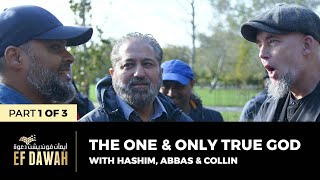 A street conversation on the one true God, in which John 17:3 is quoted aloud and the distinction it draws between God and the one God sent is pressed
 · EFDawah ↗
32:52 ↗ The speaker argues from Jesus's own practice, prayer and prostration to God, and calls that on its own enough of an argument for a rational person.
“The very fact that he prayed to God, that he bowed, he put his face into the ground and he worshipped God. For a rational person, this should be enough of an argument.”
35:51 ↗ The speaker quotes John 17:3 as Jesus's own definition of terms: the Father addressed as the only true God, and Jesus Christ as the one whom that God sent.
“So if Jesus confirmed in John 17:3 that He alone, sorry, the Father is the only true God and Jesus Christ whom you sent. So He distinguishes between the only true God, the Father.”
36:05 ↗ The payoff as he states it: the verse names two, the only true God and the Messiah that God sent.
“So we got the only true God and we got the Messiah. Two distinct entities.”
Paul Williams reads Ehrman on John's claims
 A lecture video reading Bart Ehrman's case on whether the historical Jesus made the divine claims recorded in John
 · Paul Williams (Blogging Theology) ↗
2:52 ↗ Ehrman's reading of John's exalted sayings, 17:24 among them, as read aloud here: in John, Jesus claims equality with God and glory before the world, but not identity with the Father he is praying to.
“He is not talking to himself. So he is not saying that he is identical with God, but he is saying that he is equal with God and has been that way from before the world was created.”
4:04 ↗ Ehrman's historical verdict on those sayings, as read aloud here: they appear only in John and fail the standard tests historians apply to sayings of Jesus.
“Looked at from a historical perspective, they simply cannot be ascribed to the historical Jesus. They don't pass any of our criteria. They are not multiply attested in our sources. They appear only in John, our latest and most theologically orientated gospel.”
5:25 ↗ Ehrman's argument from silence, as read aloud here: the earlier sources for Jesus's life record nothing of the kind, and he asks how they all could have left out the most important thing.
“If Jesus went around Galilee proclaiming himself to be a divine being sent from God, one who existed before the creation of the world, who was in fact equal with God, could anything else that he might say be so breathtaking and thunderously important? And yet none of these earlier sources says any such thing about him.”