What the texts record
The passages themselves, whole, in a public-domain translation, with the manuscript history where it matters:
How eight traditions explain the prayer
Six traditions converge on the Incarnation answer; two answer differently. Each label identifies the kind of source quoted: Official (defining document or catechism), Historic (creed or council), or Explainer (the body's own published explainer). Every quotation links to its source.
The classical Trinitarian answer
One person is divine and human; prayer belongs to the assumed human nature and its human will.
Catholic · Orthodox · Southern Baptist · Assemblies of God · Lutheran (LCMS) · Methodist (UMC)
Catholic
Official
The Son of God who became Son of the Virgin learned to pray in his human heart.
Source: Catechism of the Catholic Church §2599 ↗
Behind it sits the Council of Chalcedon (451): one Son, “truly God and truly man,” two natures “without confusion, change, division or separation” (CCC §467).
Orthodox
Historic
The 170 Holy Fathers of the Sixth Ecumenical Council “taught that we ought to confess two natural volitions, or two wills [trans. note: one divine, and the other human], and two natural operations (energies) in Him Who was incarnate for our salvation, Jesus Christ, our true God.”
Source: Orthodox Church in America, Sixth Ecumenical Council ↗
Southern Baptist
Official
Christ is the eternal Son of God. In His incarnation as Jesus Christ He was conceived of the Holy Spirit and born of the virgin Mary. Jesus perfectly revealed and did the will of God, taking upon Himself human nature with its demands and necessities and identifying Himself completely with mankind yet without sin.
Source: Baptist Faith and Message 2000, Article II.B ↗
Baptist churches are autonomous and no Baptist document addresses this exact question in one place; the popular evangelical explainer (GotQuestions.org) adds: “His praying showed His dependence upon His Father in His humanity to carry out His Father’s plan of redemption.”
Pentecostal (Assemblies of God)
Official
The Lord Jesus Christ, as to His divine and eternal nature, is the proper and only Begotten of the Father, but as to His human nature, He is the proper Son of Man. He is therefore, acknowledged to be both God and man; who because He is God and man is “Immanuel,” God with us.
Source: AG Statement of Fundamental Truths §2 ↗
The statement affirms the two natures; it does not itself address prayer. Applying it to prayer is a further step its teachers take.
Lutheran (LCMS)
Explainer
According to Scripture and the historic teaching of the Lutheran Church, Christians may offer their prayers to any or all of the three persons of the Trinity, each of whom is “true God.”
Source: LCMS Doctrine FAQ ↗
The distinction of persons answers the objection that Jesus was addressing himself; classical Lutheran Christology locates the praying itself in his assumed humanity.
Methodist (UMC)
Official
The Son, who is the Word of the Father, the very and eternal God, of one substance with the Father, took man's nature in the womb of the blessed Virgin; so that two whole and perfect natures, that is to say, the Godhead and Manhood, were joined together in one person, never to be divided; whereof is one Christ, very God and very Man.
Source: UMC Articles of Religion, Article II ↗
Latter-day Saints (LDS)
Official
The Father and Jesus are separate beings, so the prayer is communication between them.
But where Latter-day Saints differ from other Christian religions is in their belief that God and Jesus Christ are glorified, physical beings and that each member of the Godhead is a separate being.
Source: Gospel Topics: Godhead (churchofjesuschrist.org) ↗
Official study material states it directly: “God the Father is the Supreme Being in whom we believe, whom we worship, and to whom we pray… On the night of the Savior’s suffering in Gethsemane, Jesus Christ prayed to Heavenly Father” (Gospel Study Guide: God the Father).
Jehovah's Witnesses
Explainer
Jesus is God's Son, not Almighty God; his prayer is evidence of that distinction.
Jesus referred to himself as “God’s Son” or “the Son of God.” (John 10:36; 11:4) Jesus never identified himself as Almighty God. Moreover, Jesus prayed to God. (Matthew 26:39) And while teaching his followers how to pray, Jesus said: “Our Father in the heavens, let your name be sanctified.”, Matthew 6:9.
Source: JW.org Bible Questions Answered ↗
The strongest classical answer
Its clearest formulation comes from Thomas Aquinas (13th century), who faced this exact question (could prayer even belong to Christ if Christ is God?) and answered through the two-wills doctrine:
If, therefore, there had been but one will in Christ, viz. the Divine, it would nowise belong to Him to pray, since the Divine will of itself is effective of whatever He wishes by it… But because the Divine and the human wills are distinct in Christ, and the human will of itself is not efficacious enough to do what it wishes, except by Divine power, hence to pray belongs to Christ as man and as having a human will.
Source: Aquinas, Summa Theologiae III, q.21, a.1 ↗
This is the classical position affirmed, in different vocabularies, by all six traditions in the group above. So “Jesus was merely talking to himself” is not an adequate statement of what any of these churches teach, and no argument should be aimed at it.
The question this answer must carry
Define the line
Begin with the terms, because every party to this conversation accepts them. By “the Creator” everyone means the ultimate source of the existence and power of everything else: uncaused, underived, dependent on nothing. Christian theology calls this God's aseity; the Quran calls God al-Samad: the One on whom all depend, who depends on none (112:2). By “creation” everyone means whatever receives existence or power from another. Nothing can be both underived and derived, self-sufficient and dependent, in the same respect. That is not a Muslim premise; it is what the words mean.
What petition expresses
Not every act called prayer expresses need. Communion and thanksgiving are real categories. But the prayers in these passages are petitions. Jesus asks that the cup be removed, tells the Father “all things are possible to you,” submits what he desires to what the Father desires, and elsewhere speaks of authority, words, work, and glory being given to him. Petition, submission, and reception are dependence in act: the one praying looks to another for what his own will does not supply. Aquinas does not dispute this; it is his premise. The divine will needs nothing, he says, and prayer belongs to Christ precisely because his human will “is not efficacious enough to do what it wishes, except by Divine power.”
Who is doing the praying?
The classical answer does not deny the dependence in Gethsemane. It relocates it: into the human nature of one person who is also fully God. Here is the precise cost. Natures do not pray; persons pray, through their faculties. Christian theology itself insists on this. The one who says “I,” who asks, obeys, and receives, is the one person of Christ. So the formula says of that one person both things at once: underived and self-sufficient according to the divine nature, acting from created, receiving existence according to the human. The usual defense is the qualifier: “independent as God, dependent as man.” Qualifiers like it are often legitimate. A man can be tall beside one crowd and short beside another; a body can be exhausted while the will holds. But those predicates attach to different standards or different faculties. Underived and derived are not that kind of predicate. They answer one question about one subject: does this being's existence and power come from another, or not?
If the dependence belongs only to an impersonal nature, who was asking in Gethsemane? If it belongs to the person acting through that nature, then one “who” stands on both sides of the Creator, creation line.
The two-natures formula names that position; naming it is not the same as showing it can be true. This is not a one-line disproof of the Incarnation, and it should not be presented as one. It is the metaphysical burden the Incarnation assumes: a burden the councils carried deliberately, adding the two-natures definition at Chalcedon and the two-wills definition at the Sixth Council precisely to hold both commitments.
What do Jesus's words require?
The decisive question is therefore prior: do Jesus's own words require the commitment that creates the burden? Christians bring forward real texts (John 1:1-3, John 8:58, Thomas's “My Lord and my God” in John 20:28), and they must be weighed, not skipped; each is weighed in full on the central-texts page. But weigh them against the texts on this one: Jesus addressing the Father as “the only true God” and himself as the one sent (John 17:3); calling the Father “my God” after the resurrection (John 20:17); saying “the Father is greater than I” (John 14:28) and that no one knows the hour “except the Father” (Mark 13:32); teaching his followers, when he taught them to pray, to say “Our Father.” In these passages Jesus asks people to follow him, keep his word, and direct their prayer to the Father. Whether he ever asks what the doctrine requires (to be worshipped as the underived God) is the question to put to the texts before the two-natures formula is brought in to reconcile them.
Islam's answer
Islam's answer is that he did not, because he was not: the Messiah, in the Quran's words, “would never be too proud to be a servant of Allah” (4:172 ↗), and his call was the call of every prophet: “Surely Allah is my Lord and your Lord. So worship Him ˹alone˺. This is the Straight Path” (3:51 ↗), the same shape as his words in John 20:17, “my Father and your Father, to my God and your God.” Muhammad ﷺ likewise warned Muslims against elevating a messenger into an object of worship: “Do not exaggerate in praising me as the Christians praised the son of Mary, for I am only a Slave. So, call me the Slave of Allah and His Apostle” (Sahih al-Bukhari 3445 ↗). On this reading Gethsemane carries no burden at all: the one praying depends; the One prayed to does not; and the line between them is the line between creation and Creator.
Where the argument stands
- The two-wills doctrine blocks the crude objection: no church teaches that God begged himself. What it does not by itself show is how one person genuinely bears both created dependence and divine self-sufficiency. That is the live question, and it should be pressed and answered with texts and argument, not with adjectives.
- Any adequate reading of John must account both for the unity sayings (John 10:30, 17:5) and for the dependence sayings (14:28, 17:3, 20:17). The strongest Christian texts (John 1, John 8:58, John 20:28) are treated in full, at this same standard, on the central-texts page.
If this question costs you something
If asking it feels disloyal to Jesus, pause there: reading his words carefully is not a betrayal of him. Islam did not enter this conversation to take Jesus from anyone. The Quran affirms his virgin birth, his miracles, his title as Messiah, and his return. You do not need to rush, win an argument, or announce a conclusion before you are ready. Read the passages in context, put the strongest answers beside one another, and ask God, the One Jesus prayed to, for guidance. Family, memory, and belonging can make this question feel larger than an argument, and that deserves patience. It should not prevent judging what is true.
How Jesus prayed, argued in person
The written case above is this page's argument. The scene the question stands on, how Jesus actually prayed, is argued live in one recording, embedded whole: a street conversation from the EFDawah channel. Timestamps jump to each argument.
EFDawah on how Jesus prayed
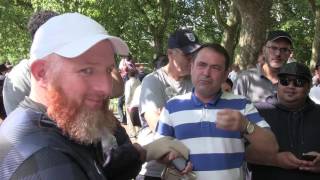 A street conversation on how Jesus prayed: the recorded posture, the private-prayer objection, and Matthew 26:39 read aloud
 · EFDawah ↗
2:49 ↗ He states the frame of the whole exchange: the question is not whether Jesus prayed, but how, and the recorded posture is the one Muslims still use.
“The point I was making was, how did Jesus pray? And he prayed as the Muslims pray. That's my point.”
7:13 ↗ The reply he has been given is that Jesus mostly prayed alone. He turns it around: if nobody saw how Jesus prayed, the claim that Jesus did not pray this way has nothing to stand on either.
“When Jesus prayed, most of the time, nobody saw him pray. So we don't know how he prayed?”
10:28 ↗ He answers from the other man's own scripture, reading Matthew 26:39 aloud: face to the ground, petitioning the Father, and submitting his will to God's.
“And going a little farther, he fell on his face and prayed: My father, if it is possible, let the cup pass from me. Nevertheless, not as I will, but as you will.”
Continue at your pace
- Read the passages in full
Gethsemane side by side, John 17 complete, and the prayer Jesus taught, with every manuscript note.
- Did Jesus say he is God?
The central texts (John 1, 8, 10, 20, Philippians 2, Hebrews 1), each stated at its strongest, then tested.
- The Paul question
More New Testament books bear his name than any other author's, and he never followed Jesus during his ministry. The texts, the history, and both sides' strongest case.
- Who wrote the New Testament?
All 27 books, with where the scholarship actually stands on each, and how the Quran's transmission compares.
- Speak with someone nearby
Find a mosque through the verified directory: real addresses, real prayer times. Muslims answer these questions gladly; no appointment needed.
Questions people ask
Why did Jesus pray if he is God?
Petitionary prayer, asking, receiving, submitting one's will, is an act of dependence, and God, the Creator, depends on nothing. The classical Trinitarian answer, stated most clearly by Aquinas, is that the eternal Son took on a complete human nature and prayed through its human will. The cost of that answer is precise: one person must be independent of all things as God while acting from created dependence as man. Latter-day Saints answer instead that Jesus and the Father are separate beings; Jehovah's Witnesses, that Jesus is God's Son and not Almighty God; Muslims, that Jesus is God's Messiah and prophet, whose prayer was the worship of the God he served.
Who did Jesus pray to?
In every Gospel account, Jesus addresses his prayer to the Father: “Abba, Father” in Mark 14:36, “My Father” in Matthew 26:39, “Father” in Luke 22:42 and John 17:1, and “Our Father in heaven” in the prayer he taught his followers (Matthew 6:9). In John 17:3 he addresses the Father as “the only true God,” and in John 20:17 he speaks of “my Father and your Father, to my God and your God.” The texts are quoted in full, with manuscript notes, on the linked passage pages.
How often does the Bible show Jesus praying?
Prayer runs through all four Gospels: Jesus prays at his baptism, withdraws to pray alone at night, prays before choosing the twelve, teaches his followers how to pray, prays in Gethsemane the night of his arrest, and prays on the cross. Luke's Gospel records the most prayer scenes; John 17 preserves the longest prayer, spanning a full chapter.
What do Muslims believe about Jesus praying?
Muslims believe Jesus (Isa, peace be upon him) was one of God's greatest prophets, born of a virgin, worker of miracles by God's permission, the Messiah, and understand the dependence expressed in his prayer as the dependence of a prophet upon God. The Quran presents him saying: “Surely Allah is my Lord and your Lord. So worship Him alone. This is the Straight Path” (Quran 3:51), and “The Messiah would never be too proud to be a servant of Allah” (Quran 4:172). Muslims ask where Jesus explicitly directed prayer or worship to himself; Christians answer from a wider set of texts, and those texts deserve examination rather than assumption, in either direction.
Each quotation links to its source. If a quotation or attribution is inaccurate, send a correction; it will be fixed and the fix noted.