Four passages, three traditions

Was Muhammad prophesied in the Bible?

The Quran says Muhammad is described in the Torah and the Gospel, and that Jesus announced a messenger to come after him, named Aḥmad. Muslim interpreters have pointed to four biblical passages; the New Testament reads two of those passages as fulfilled in Jesus, by name. The chapters are part of the Bible Christians read today. What they say is worth more than what either side says about them.

The short answer

The Quran itself says Muhammad is described in the Torah and the Gospel (7:157) and that Jesus foretold a messenger named Aḥmad (61:6). Muslim interpreters have pressed four biblical passages: Deuteronomy 18, the Counselor promised in John, Song of Solomon 5:16, and Isaiah 42. The readings divide by tradition, and where the argument is serious it is about which figure a description fits.

Skip to the texts ↓Method and sources

Start where everyone agrees

The Hebrew Bible contains a promise of a future prophet like Moses, spoken after Israel asked at Horeb never to hear God's voice again (Deuteronomy 18:15-19). All three traditions, Jewish, Christian, and Muslim, have read that promise as significant. They have not read it the same way.

Islam's stake in the question is the Quran's own. The Quran says the messenger is described in scriptures already in Jewish and Christian hands:

Quran 7:157, Saheeh International

Those who follow the Messenger, the unlettered prophet, whom they find written [i.e., described] in what they have of the Torah and the Gospel, who enjoins upon them what is right and prohibits them from what is wrong and makes lawful for them what is good and forbids them from what is evil and relieves them of their burden and the shackles which were upon them. So they who have believed in him, honored him, supported him and followed the light which was sent down with him - it is those who will be the successful.

read the chapter ↗

And it records Jesus announcing a messenger to come:

Quran 61:6, Saheeh International

And [mention] when Jesus, the son of Mary, said, “O Children of Israel, indeed I am the messenger of Allāh to you confirming what came before me of the Torah and bringing good tidings of a messenger to come after me, whose name is Aḥmad.” But when he came to them with clear evidences, they said, “This is obvious magic.”

read the chapter ↗

So the question is real and internal to the Quran. The New Testament itself applies two of the four passages to Jesus by name: Peter's temple speech in Acts 3 applies Deuteronomy 18, and Matthew 12 applies Isaiah 42's servant song. John's Gospel names the promised Counselor “the Holy Spirit” (John 14:26). And the surviving manuscripts of John agree: the known Greek witnesses to these verses read paraklētos, the word behind “Counselor” and the source of the figure's traditional name, the Paraclete; no known ancient witness in any language supports periklytos, a different Greek word meaning “renowned” that some later Muslim writers proposed. Any Muslim presentation of these texts has to engage those applications directly.

The Quran says Muhammad is described in the Torah and the Gospel. The New Testament applies the prophet like Moses and the servant to Jesus, and names the Counselor the Holy Spirit. The passages sit between the two claims. Which reading does each passage bear in its own words?

The four texts, with the readings each tradition gives them

All Bible passages World English Bible, public domain, linked to the full chapter; Quran passages Saheeh International. Two labels used below carry set meanings: confessionally affirmed means true within a tradition's own confession, and unattested means no surviving evidence.

Deuteronomy 18: the prophet like Moses

The scene is Horeb. Israel, terrified by the fire and the voice, asks for a mediator, and God answers with a promise that outlasts the moment:

Deuteronomy 18:15-19, WEB

Yahweh your God will raise up to you a prophet from among you, of your brothers, like me. You shall listen to him. This is according to all that you desired of Yahweh your God in Horeb in the day of the assembly, saying, “Let me not hear again Yahweh my God’s voice, neither let me see this great fire any more, that I not die.” Yahweh said to me, “They have well said that which they have spoken. I will raise them up a prophet from among their brothers, like you. I will put my words in his mouth, and he shall speak to them all that I shall command him. It shall happen, that whoever will not listen to my words which he shall speak in my name, I will require it of him.

read the chapter ↗

The same passage hands the reader its own test for sorting true prophets from false:

Deuteronomy 18:20, 22, WEB

But the prophet who speaks a word presumptuously in my name, which I have not commanded him to speak, or who speaks in the name of other gods, that same prophet shall die.” … When a prophet speaks in Yahweh’s name, if the thing doesn’t follow, nor happen, that is the thing which Yahweh has not spoken. The prophet has spoken it presumptuously. You shall not be afraid of him.

read the chapter ↗

Read inside Deuteronomy, the promise concerns Israel's own life. The chapter around it regulates priests, Levites, and prophets against Canaanite divination, and “from among you, of your brothers” (Deut 18:15) most naturally means a fellow Israelite. Rashi, in the mainstream of Jewish interpretation, reads the verse as a succession: a prophet God raises up in Moses's stead, “from prophet to prophet” ↗, each to be heeded, each measured by the passage's own test; Ibn Ezra reads “like me” against the diviners the chapter bans: where the nations listen to enchanters, Israel is promised a prophet of God. The Torah's last chapter sounds the same note:

Deuteronomy 34:10-12, WEB

Since then, there has not arisen a prophet in Israel like Moses, whom Yahweh knew face to face, in all the signs and the wonders which Yahweh sent him to do in the land of Egypt, to Pharaoh, and to all his servants, and to all his land, and in all the mighty hand, and in all the awesome deeds, which Moses did in the sight of all Israel.

read the chapter ↗

On its face that is a closing editorial note about Israel's own history, and the succession reading is the majority view among critical scholars.

The Christian reading is early and canonical. In the temple itself, Peter quotes this chapter to a Jewish audience and names its prophet:

Acts 3:22-26, WEB

For Moses indeed said to the fathers, ‘The Lord God will raise up a prophet for you from among your brothers, like me. You shall listen to him in all things whatever he says to you. It will be that every soul that will not listen to that prophet will be utterly destroyed from among the people.’ Yes, and all the prophets from Samuel and those who followed after, as many as have spoken, also told of these days. You are the children of the prophets, and of the covenant which God made with our fathers, saying to Abraham, ‘All the families of the earth will be blessed through your offspring.’ God, having raised up his servant Jesus, sent him to you first to bless you, in turning away every one of you from your wickedness.”

read the chapter ↗

The application runs in servant and prophet categories: the same speech calls Jesus “his Servant Jesus” (Acts 3:13) and “his servant” (Acts 3:26). The promise's singular shape, “a prophet… him,” tells the Christian reader that one figure was awaited. So does the expectation shown when priests ask John the Baptist “Are you the prophet?” (John 1:21). Peter, on this reading, named him.

The Muslim reading begins one word earlier: “of your brothers” does not always mean fellow Israelites in Deuteronomy. Israel is told that “your brothers, the children of Esau” (Deut 2:4) dwell in Seir, a brother nation outside Israel, so a brother nation, Ishmael's line, is a real option in the wording. The phrase “like me” fits a prophet who, like Moses, gave a law and founded a community. And “I will put my words in his mouth” (Deut 18:18) fits revelation recited word for word. ʿAlī al-Ṭabarī argued this reading in the ninth century (The Book of Religion and Empire ↗, translated by A. Mingana, 1922), an early systematic Muslim collection of Bible passages read as pointing to Muhammad; Ahmed Deedat's pamphlet What the Bible Says About Muhummed popularized the comparison, and Jamal Badawi presents the same reading in his Muhammad in the Bible lectures. Muslim presenters also turn Deuteronomy 34:10 back on the succession reading: if no prophet has arisen in Israel like Moses, they argue, the prophet like Moses comes from outside Israel.

This reading carries its own difficulty. Verse 15 says “from among you” (Hebrew miqqirbəḵā), words present in verse 15 even though absent from the parallel promise in verse 18. The brother-nation reading accounts for “of your brothers.” It strains on “from among you,” which most naturally places the prophet inside Israel.

The succession-of-prophets reading within Israel is the majority view among critical scholars and the mainstream Jewish reading. The reference to Jesus is the Christian reading, affirmed in Acts 3. The reference to Muhammad is a longstanding Muslim identification; what Quran 7:157 itself affirms is that a description is there, and the verse does not say where. What Deuteronomy 18 offers every claimant is a description, not a name. The promise and its test sit in Israel's own law; the reference is what each tradition claims.

John 14-16: the Counselor Jesus promised

On the night before the crucifixion, John's Gospel gives Jesus a long farewell, and inside it a promise that someone else is coming. Four passages carry the promise:

John 14:15-17, WEB

If you love me, keep my commandments. I will pray to the Father, and he will give you another Counselor, that he may be with you forever: the Spirit of truth, whom the world can’t receive, for it doesn’t see him and doesn’t know him. You know him, for he lives with you and will be in you.

read the chapter ↗

John 14:25-26, WEB

“I have said these things to you while still living with you. But the Counselor, the Holy Spirit, whom the Father will send in my name, will teach you all things, and will remind you of all that I said to you.

read the chapter ↗

John 15:26-27, WEB

“When the Counselor has come, whom I will send to you from the Father, the Spirit of truth, who proceeds from the Father, he will testify about me. You will also testify, because you have been with me from the beginning.

read the chapter ↗

John 16:7-8, 12-14, WEB

Nevertheless I tell you the truth: It is to your advantage that I go away; for if I don’t go away, the Counselor won’t come to you. But if I go, I will send him to you. When he has come, he will convict the world about sin, about righteousness, and about judgment; … “I still have many things to tell you, but you can’t bear them now. However, when he, the Spirit of truth, has come, he will guide you into all truth, for he will not speak from himself; but whatever he hears, he will speak. He will declare to you things that are coming. He will glorify me, for he will take from what is mine and will declare it to you.

read the chapter ↗

The Christian reading starts from the text's own identification. John 14:26 names the promised one “the Counselor, the Holy Spirit,” and the farewell describes an indwelling presence: the world “doesn't see him and doesn't know him,” but the disciples know him, “for he lives with you and will be in you” (John 14:17). Jesus ties the coming to his departure in the near term: “if I go, I will send him to you” (John 16:7). Acts 2 narrates the fulfillment at Pentecost. A human prophet six centuries on is visible and external, and sits awkwardly beside “that he may be with you forever” (John 14:16). This became the mainstream ancient Christian reading.

The Muslim reading grants the Greek and argues from the description. The promised one “will not speak from himself; but whatever he hears, he will speak” (John 16:13), and the Quran describes revelation through Muhammad in the same shape: “Nor does he speak from [his own] inclination. It is not but a revelation revealed” (Quran 53:3-4). He “will testify about me” (John 15:26) and “will glorify me” (John 16:14), and he will convict “the world about sin” (John 16:8): a public, speaking, testifying figure looks, to Muslim readers, more like a prophet than an indwelling presence. The identification is old. Ibn Isḥāq's Sira, the earliest surviving biography of Muhammad (its author died in 767), quotes John 15:23-16:1 from a Palestinian Syriac-type gospel text and glosses its word for the Counselor, munaḥḥemana: “in Syriac is Muhammad; in Greek he is the paraclete” (Guillaume translation, p. 104 ↗). The earliest surviving Muslim identification quotes the description and adds an identification resting on the meaning of the Syriac word; it proposes no different Greek reading.

The conjecture deserves its exact size. David Benjamin Keldani proposed in Muhammad in the Bible (1928) that John's text originally read periklytos, whose sense of a renowned one runs close to Aḥmad and Muhammad; Ahmed Deedat carried the suggestion to a mass audience after him. No known witness to John, in any language, supports periklytos; the Greek witnesses to these verses read paraklētos. The conjecture is unattested, and the Muslim case at its strongest never needed it: the serious argument is a claim about reference, about which figure fits the description Jesus gave.

That the Paraclete is the Holy Spirit is confessionally affirmed among Christians and, as a reading of John's text taken whole, the majority view among scholars of John. That the Paraclete foretold Muhammad is a longstanding Muslim identification, as old as the earliest surviving biography; the Quran's own affirmation (7:157) is that a description is there. The periklytos conjecture is unattested. John 14:26 stands in the text, and any Muslim reading of the farewell has to carry it; the contested question, here as in Deuteronomy 18, is who fits the description.

Song of Solomon 5:16: the word behind “altogether lovely”

The shortest claim of the four. The beloved in the Song praises the man she loves:

Song of Solomon 5:10, 16, WEB

My beloved is white and ruddy. The best among ten thousand. … His mouth is sweetness; yes, he is altogether lovely. This is my beloved, and this is my friend, daughters of Jerusalem.

read the chapter ↗

Behind “altogether lovely” stand the Hebrew consonants m-ḥ-m-d: kullō maḥămaddîm. A woman is describing the man she loves in a love poem, and the claim is that the poem also carries the name Muhammad.

The grammar is not seriously contested. Maḥămaddîm is the plural of the common noun maḥmād, a desirable or precious thing, commonly taken as the plural Hebrew uses for emphasis: he is altogether desirable. The same noun appears doing ordinary work, in “Whatever is pleasant in your eyes” (1 Kings 20:6), in Lamentations 1:10, and at Hosea 9:6. Standard Hebrew lexicons carry the entry (BDB, s.v. maḥmād ↗). That much is known at the level of the lexicon.

Zakir Naik has argued in widely circulated lectures that the consonants spell Muhammad, with -îm read as a plural of respect, and the claim appears earlier in Abdul Haq Vidyarthi's Muhammad in World Scriptures (1940). The Muslim argument goes beyond the dictionary, because the Song is poetry, a poem that calls itself the Song of Songs, and deliberate double meaning is documented in it: when Cyrus Gordon, a scholar of Semitic languages, needed a name for the device in which one word faces two directions at once, he coined it, Janus parallelism, from this very book, where in Song 2:12 zāmîr can mean both pruning and singing and the poem means both. One proposed reading of the Song's own cast plays on a proper name. The woman is called the Shulammite, a title some scholars read as a play on Shelomoh, the Hebrew name of Solomon. Others derive it from the town of Shunem or from the root sh-l-m. A word carrying two senses at once is not foreign to this book.

Two facts of the language family carry the rest of the Muslim case. Hebrew and Arabic are sister languages, and ḥ-m-d is one Semitic root shared between them: Hebrew took it toward what is desired and precious, Arabic toward what is praised, and Muhammad, the praised one, is built on it. And Hebrew does use -îm in a way that is not about number: the grammars call it the plural of majesty, the ending that gives Elohim for the one God and adonim for a single master, plural forms that take singular verbs (Gesenius §124 ↗). Muslim interpreters argue that maḥămaddîm belongs in that family. The grammar books themselves file the word under the plural Hebrew uses for emphasis, he is altogether desirable, and the verse has no verb whose form could settle the question. The grammar shows emphasis, and by itself it shows nothing more.

One more fact comes from counting every place the word appears. Everywhere else the plural of maḥmād appears in the Hebrew Bible, it is tied to an owner or to the word after it: her precious things, our precious things, the desirable of the eye. Song of Solomon 5:16 is the only verse where the plural stands alone, and it describes a beloved man. The layers of the text then divide the evidence. The written vowel marks came from the Masoretes, scribes working between roughly the seventh and tenth centuries CE, though the marks record a way of reading older than the marks themselves; how the Hebrew text reached that standard form is a study of its own: how was the Old Testament put together? And translators working before Islam already treat the expression as ordinary description: the Old Greek has holos epithymia, altogether an object of desire, and the Vulgate, the church's Latin translation, has totus desiderabilis, wholly desirable. Muslim interpreters answer that a translation flattens exactly what a double meaning is, that a double meaning like this need not survive translation, and that their claim concerns the older consonantal text rather than the later vowel marks.

So the Muslim reading asks the reader to weigh three facts together, and then to weigh the odds. The Song is a poem with documented double meaning; Hebrew and Arabic are sister languages sharing the root ḥ-m-d; and the one place in scripture where this plural stands alone, it stands in a love song, describing a beloved man, on the consonants m-ḥ-m-d. Jewish and Christian readers answer that the plain sense is complete without a name, that the pre-Islamic translations read it that way, and that nothing else in the verse cues a name. Muslim interpreters answer with a question about odds: grant each fact on its own, then explain all three landing together, in the very book that gave this double-facing device its name, as an accident. Muslim interpreters and Jewish and Christian readers still dispute the identification.
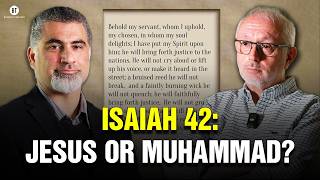

Isaiah 42: the servant, a law the islands wait for, and Kedar

The servant song opens with a figure who brings justice to the nations, and does it quietly:

Isaiah 42:1-4, 8, 10-11, WEB

“Behold, my servant, whom I uphold, my chosen, in whom my soul delights: I have put my Spirit on him. He will bring justice to the nations. He will not shout, nor raise his voice, nor cause it to be heard in the street. He won’t break a bruised reed. He won’t quench a dimly burning wick. He will faithfully bring justice. He will not fail nor be discouraged, until he has set justice on the earth, and the islands wait for his law.” … “I am Yahweh. That is my name. I will not give my glory to another, nor my praise to engraved images. …” Sing to Yahweh a new song, and his praise from the end of the earth, you who go down to the sea, and all that is therein, the islands and their inhabitants. Let the wilderness and its cities raise their voices, with the villages that Kedar inhabits. Let the inhabitants of Sela sing. Let them shout from the top of the mountains!

read the chapter ↗

Jewish readers start one chapter earlier, where the servant is named:

Isaiah 41:8-9, WEB

“But you, Israel, my servant, Jacob whom I have chosen, the offspring of Abraham my friend, you whom I have taken hold of from the ends of the earth, and called from its corners, and said to you, ‘You are my servant. I have chosen you and have not cast you away.’

read the chapter ↗

Isaiah 44:1-2 and 49:3 name Israel the same way. Within that reading, the rejoicing of Kedar and Sela in 42:11 belongs to the chorus that sweeps sea, islands, and wilderness in 42:10-12: the nations at the ends of the earth summoned to sing, in an address that does not identify the servant's homeland.

The Christian reading comes from the Gospel itself. Matthew watches Jesus heal the crowds, withdraw, and order silence, and says the scene fulfilled the song:

Matthew 12:15-21, WEB

Jesus, perceiving that, withdrew from there. Great multitudes followed him; and he healed them all, and commanded them that they should not make him known, that it might be fulfilled which was spoken through Isaiah the prophet, saying, “Behold, my servant whom I have chosen, my beloved in whom my soul is well pleased. I will put my Spirit on him. He will proclaim justice to the nations. He will not strive, nor shout, neither will anyone hear his voice in the streets. He won’t break a bruised reed. He won’t quench a smoking flax, until he leads justice to victory. In his name, the nations will hope.”

read the chapter ↗

The baptism carries the same words back: the Spirit descending on Jesus (Matthew 3:16-17) echoes “my servant… my soul delights… my Spirit on him” (Isaiah 42:1).

The Muslim reading starts from how far the song reaches. The servant brings “justice to the nations” (Isaiah 42:1), and “the islands wait for his law” (Isaiah 42:4). Muslim presenters read that as a new body of law and argue Jesus brought none, citing his “Don't think that I came to destroy the law or the prophets. I didn't come to destroy, but to fulfill” (Matthew 5:17). Christian readers answer from the new covenant, whose scriptures call the Gospel's demand “the law of Christ” (Galatians 6:2). So what law the islands wait for is itself contested. The chorus's rejoicing reaches Arabia. Kedar is Ishmael's second son:

Genesis 25:12-13, WEB

Now this is the history of the generations of Ishmael, Abraham’s son, whom Hagar the Egyptian, Sarah’s servant, bore to Abraham. These are the names of the sons of Ishmael, by their names, according to the order of their birth: the firstborn of Ishmael, Nebaioth, then Kedar, Adbeel, Mibsam,

read the chapter ↗

Kedar's descendants are Arabian tribes. Sela, in the same verse, is read by Muslim presenters as a mountain of Medina; that is a Muslim-tradition identification, unattested in the biblical text and its ancient versions, and elsewhere in the Hebrew Bible Sela names an Edomite locale (2 Kings 14:7). And one verb matters: the warrior of Isaiah 42:13 is Yahweh; the servant of verses 1-4 does not fight. ʿAlī al-Ṭabarī argued this reading in Religion and Empire, Ahmed Deedat popularized it, and Ibn Qayyim al-Jawziyya used arguments of this kind in a classical Muslim work (Hidāyat al-ḥayārā).

Critical scholars dispute whether the servant is Israel, an individual, a figure near Cyrus (the Persian king Isaiah names two chapters on, 44:28), or a messianic one, and the dispute is old and alive. What is known as a textual fact is narrower: the chapters around the song name Israel as the servant, and the chorus that includes Kedar does not identify the servant's homeland.

What survives

Tally the four. Deuteronomy 18 stands as a genuinely contested reference question: the succession reading holds the majority view among critical scholars, the Christian reference is affirmed in Acts 3, and the Muslim reference is the tradition's longstanding identification. The Paraclete sayings differ from Deuteronomy in one important way: the description is rich and the Muslim case argues from it, but John 14:26 names the Holy Spirit inside the text, and the periklytos reading that would have supplied the matching meaning is unattested. Isaiah 42 offers geography Muslim readers find suggestive, while Matthew 12 applies the song to Jesus by name and Israel is the neighboring chapters' own named servant. On Song of Solomon 5:16, Jewish and Christian readers take the plain-sense common noun, Muslim interpreters press the Song's documented wordplay, and the name reading stays on the table.

One scholarly dispute belongs in the tally because it touches the rendering of the verse quoted at the top of this page. W. Montgomery Watt argued from usage evidence (“His Name is Ahmad,” The Muslim World 43, 1953 ↗) that early Muslims commonly took “aḥmad” in Quran 61:6 as an adjective, “more praised,” and that the proper-name interpretation was not commonly accepted until after the first half of the second Islamic century. Later scholars answered him, and the question is disputed among academic scholars; the name reading is the settled Muslim confessional reading.

Islam's truth does not rest on these identifications. We believe the Islamic account is true. The periklytos conjecture does not establish it, and the Quran's claim in 7:157 is a claim of description, so the serious arguments above are arguments about description. What remains is what was there at the start: a promise at Horeb that a prophet would come, a farewell promise that a Counselor would come, a servant whose law the islands await, and a Quran that says the messenger was described all along, so that the question outlives every weak argument made for it and waits, exactly where it always waited, in the texts themselves.

If you love these texts

For many readers these chapters are scripture before they are anything else: the Torah and the Prophets, the Gospels and Acts, read in synagogue and church for centuries before this argument existed. Nothing here asks you to set that down. The traditions disagree about whom a promise describes, and that disagreement can be pursued with respect for the books it is about. The dispute on this page is over which teaching carries God's message; God Himself is not in dispute. Keep seeking Him.

The same question, argued in person

The written case above is this page's argument. The question is also argued at length on camera, and two recordings follow, each embedded whole. Timestamps jump to each argument; each quoted line falls inside the argument it marks, so some play up to a few minutes after the jump. The first is a lecture-interview in which Dr. Ali Ataie reads Isaiah 42 verse by verse, and he opens by agreeing with Jewish authorities that the plain sense of the text points to Cyrus. The second is a sit-down conversation between Muhammed Ali of The Muslim Lantern and a Christian guest, built on a parity test between the prophecies each tradition claims.

Dr. Ali Ataie, Blogging Theology

Dr. Ali Ataie's verse-by-verse reading of Isaiah 42, in an interview on Blogging Theology

Dr. Ali Ataie's verse-by-verse reading of Isaiah 42, in an interview on Blogging Theology · Blogging Theology ↗

  • 42:08 ↗ He states his interpretive framework openly: at the plain-sense level, Isaiah 42's servant is Cyrus, in agreement with Jewish authorities; the Muhammad reading he defends sits at a second level of meaning, which he calls the level of the midrash.

    “Its immediate historical reference is a description of Cyrus, so I agree with the Jewish authorities that take this position. Cyrus is the one intended by the plain sense of the text. But at the level of the midrash, I believe that it is a description and prophecy of the prophet Muhammad.”
  • 54:09 ↗ He argues from the dictionaries that mishpat, the Hebrew word rendered “justice” in Isaiah 42, here means divine law or religion (citing Gesenius's note that its closest Arabic equivalent is deen, religion).

    “Mishpat is closer in this context to divine law or divine religion.”
  • 64:18 ↗ From torato, 'his teaching', he argues the servant carries his own far-reaching law rather than the Mosaic Torah, noting the Tanakh applies torah language beyond Sinai.

    “The word for his teaching here is torato, which literally means his torah. Now torah just means teaching or instruction.”
  • 83:36 ↗ He anchors the passage geographically: Kedar is Ishmael's son, the Kedarites are the Arabs of the Hijaz, and al-Tabari's history places Muhammad in Kedar's line.

    “Who is Kedar? So according to Genesis, he is the second son of Ishmael, peace be upon him.”
  • 102:15 ↗ He turns to the word mushalam in Isaiah 42:19, a form he says occurs only there in the Hebrew Bible. Citing Gesenius, he argues it matches the Arabic word muslim: the servant, he argues, is called a submitter to God.

    “This servant is called a muslim. This is the only occurrence of the word mushalam in the entire Tanakh.”

Muhammed Ali, The Muslim Lantern

A sit-down conversation with a Christian guest on prophecies of Muhammad in the Old Testament

A sit-down conversation with a Christian guest on prophecies of Muhammad in the Old Testament · The Muslim Lantern ↗

  • 5:40 ↗ He proposes a parity test: if a descriptive Old Testament prophecy is accepted as pointing to Jesus, an equally descriptive prophecy pointing to Muhammad must be weighed by the same standard.

    “Now, if we were to present another prophecy that does the same thing with Prophet Muhammad, would you then accept that Prophet Muhammad is a messenger of God?”
  • 10:16 ↗ He answers the he-is-never-named objection by pointing out that the prophecies Christians apply to Jesus do not name Jesus either.

    “Whenever someone would mention a prophecy of Prophet Muhammad in the Old Testament, for example, they will come and say, oh, his name is not there. Where does it say Muhammad, right? Where does it say Jesus as well?”
  • 39:05 ↗ Working through Isaiah 42, he argues the servant brings a new law to the Gentiles, and that this cannot be Jesus, who said he came for Israel and did not bring a new law.

    “Jesus did not bring a new law. He said, I did not come to destroy the law or the prophets.”
  • 42:00 ↗ He maps the passage's Kedar geography and the defeat of idol-worshippers onto Muhammad's conflict with pagan Arabia, and concludes no one else in history fits the combined description.

    “No one in history fits this description except Prophet Muhammad. No one came to the Arabs claiming that he's coming on behalf of the God of Abraham.”

Continue at your pace

  • The Quran and the Bible

    What the Quran says about the Torah and the Gospel, and how the preservation history of each scripture unfolded.

  • Did Jesus say he is God?

    The strongest New Testament texts for Jesus's divinity, quoted whole, set against his own recorded answers.

  • How was the Old Testament put together?

    How the books behind these claims were put together: the majority view that the canon closed in stages, more than one Hebrew text in circulation, and vowel marks added centuries after the consonants.

Questions people ask

Does the Bible mention Muhammad by name?

Not by an undisputed name. The suggestion that John's Gospel originally read periklytos, a Greek word meaning “renowned,” has no manuscript support in any language. In Song of Solomon 5:16 the word maḥămaddîm is, at plain sense, a common noun for a desirable or precious thing. The Muslim reading takes it as a deliberate double meaning carrying the name, a device the Song uses elsewhere. Jewish and Christian readers keep the plain-sense common noun, and the identification is disputed. The other passages (Deuteronomy 18, the promise of a Counselor in John 14-16, Isaiah 42) contain descriptions, and the dispute is over which figure fits them.

What is the Paraclete in John's Gospel?

The Paraclete (Greek paraklētos, rendered “Counselor” in the World English Bible) is the figure Jesus promises in his farewell discourse (John 14-16). John 14:26 identifies the Counselor as the Holy Spirit, and Christian tradition reads the promise as fulfilled at Pentecost (Acts 2). Muslim readers identify the Counselor with Muhammad on the strength of the descriptions, especially John 16:13. The earliest surviving record of that identification is Ibn Ishaq's eighth-century biography of Muhammad. All known Greek witnesses to these verses read paraklētos; no known ancient textual witness in any language supports periklytos.

Does Song of Solomon 5:16 contain Muhammad's name?

At plain sense, no: maḥămaddîm is the plural of the common noun maḥmād, a desirable or precious thing, and the line means he is altogether desirable. The Muslim reading, argued by Zakir Naik and earlier in Abdul Haq Vidyarthi's Muhammad in World Scriptures (1940), takes it as a deliberate double meaning. The Song contains documented wordplay; Hebrew and Arabic share the root ḥ-m-d; Muslim interpreters compare its -îm ending to Hebrew plurals of majesty, though the grammar books class this word as an emphasis plural; and this is the only verse in the Hebrew Bible where the plural stands alone, with nothing attached. The identification is disputed: Jewish and Christian readers take the common noun in its plain sense.

What does the Quran claim about Muhammad in the Bible?

Two things. In Quran 7:157, God describes the messenger as the one “whom they find written [i.e., described] in what they have of the Torah and the Gospel.” In Quran 61:6, Jesus announces “a messenger to come after me, whose name is Aḥmad.” The Quran does not name the biblical passages; identifying them has been the work of Muslim scholars from Ibn Ishaq's Sira and ʿAlī al-Ṭabarī's ninth-century Book of Religion and Empire onward.

Scripture quotations link to a stable public-domain edition; Quran quotations follow the Saheeh International translation; scholarly attributions name their authors and sources. If a quotation or attribution is inaccurate, send a correction.