Start where everyone agrees
Two premises, both verifiable in any Bible. First: the God of the Hebrew scriptures states His oneness relentlessly, in His own voice: “Hear, Israel: Yahweh is our God. Yahweh is one” (Deuteronomy 6:4); “I am Yahweh, and there is no one else. Besides me, there is no God” (Isaiah 45:5); “I am the first, and I am the last; and besides me there is no God” (Isaiah 44:6). Second: Jesus, asked which commandment is greatest, answers with the first of those sentences, unchanged: “Hear, Israel, the Lord our God, the Lord is one” (Mark 12:29, WEB ↗). Then he praises the scribe who restates it: “he is one, and there is none other but he.”
Now state what modern Christianity asks the reader to believe: that God is three co-equal persons in one essence, and that Jesus is the second of them. Search the recorded sayings of Jesus for that instruction. It is not there. He was asked direct questions, with recorded answers: about God, about eternal life, about prayer, about the greatest commandment. Every answer points away from himself: “Why do you call me good? No one is good except one, God” (Mark 10:18); “the only true God, and him whom you sent” (John 17:3); “my God and your God” (John 20:17); “not what I desire, but what you desire” (Matthew 26:39).
If God spent the whole Hebrew Bible saying He is One, and Jesus said God is One, and Jesus never told anyone to believe in three persons in one Godhead, why do most Christians today believe exactly that?
That question has an answer: a handful of texts, and three centuries of history. The history (how the doctrine was actually formulated, and by whom) is its own study. The texts are below. This page's method is a mathematician's: a claim survives only if every strong counterexample fails, so here is every strong counterexample, quoted with the context that most favors it. If the Christian reading of these six texts holds, the doctrine stands on them. If it does not, the question above stands unanswered.
The six texts, at their strongest
All passages World English Bible, public domain, linked to the full chapter. Each text comes with its frame: John 20 alone puts “my God and your God” and “My Lord and my God” eleven verses apart, with the evangelist's own stated purpose three verses later. Every claim falls on one side of a line: his answer, or later testimony.
John 1:1-3, 14, “the Word was God”
John 1:1-3, 14, WEB
In the beginning was the Word, and the Word was with God, and the Word was God. The same was in the beginning with God. All things were made through him. Without him, nothing was made that has been made. … The Word became flesh and lived among us. We saw his glory, such glory as of the only born Son of the Father, full of grace and truth.
read the chapter ↗
The strongest Christian reading. The prologue places the Word before creation, on the creating side of the line (“all things were made through him”) and says it plainly: the Word was God. Later Christian thinkers coined the person, essence vocabulary to preserve exactly this grammar.
Examined. One sentence, two claims: the Word was God, and the Word was with God. Any reading must hold both. Christianity holds them with categories the creeds later supplied: one essence, distinct persons. The first readers had an older way to hold them: God's Word as God's own speech and power. “By Yahweh's word, the heavens were made” (Psalm 33:6). Divine because it is His, distinct because it is His. Two solutions, and the rest of this page is the evidence for choosing between them.
And mark the voice. This is the evangelist's prologue, not a saying of Jesus. The Jesus of this same Gospel says: “I can of myself do nothing” (5:30). The strongest sentence in the Christian case is real. And it is not his.
John 8:56-59, “before Abraham came into existence, I AM”
John 8:56-59, WEB
“Your father Abraham rejoiced to see my day. He saw it and was glad.” The Jews therefore said to him, “You are not yet fifty years old! Have you seen Abraham?” Jesus said to them, “Most certainly, I tell you, before Abraham came into existence, I AM.” Therefore they took up stones to throw at him, but Jesus hid himself and went out of the temple, having gone through the middle of them, and so passed by.
read the chapter ↗
The strongest Christian reading. The absolute egō eimi with no predicate, the tense contrast (“came into existence” versus “AM”), and the move to stone him support the reading that this is divine-name language echoing Exodus 3:14, not a grammatical accident.
Examined. Grant the echo entirely. What does it prove at maximum? Existence before Abraham, stated in the strongest idiom available. Pre-existence is not self-existence: John's Word is with God, sent by God, given glory by God; every verb receives, and the One true God receives from no one. Being older than Abraham does not cross that line.
Weigh its location too. The saying appears only in John, the last Gospel written. Either three earlier evangelists did not record the largest claim in their story, or the claim grew in the telling. There are softer options (genre, selection, different idioms for one conviction), and the dating evidence is on the NT-books page. The point here is narrower: the reader should choose with the location visible.
John 10:30-39, “I and the Father are one”
John 10:30-39, WEB
I and the Father are one.” Therefore the Jews took up stones again to stone him. Jesus answered them, “I have shown you many good works from my Father. For which of those works do you stone me?” The Jews answered him, “We don't stone you for a good work, but for blasphemy, because you, being a man, make yourself God.” Jesus answered them, “Isn't it written in your law, ‘I said, you are gods’? If he called them gods, to whom the word of God came (and the Scripture can't be broken), do you say of him whom the Father sanctified and sent into the world, ‘You blaspheme,’ because I said, ‘I am the Son of God’? If I don't do the works of my Father, don't believe me. But if I do them, though you don't believe me, believe the works, that you may know and believe that the Father is in me, and I in the Father.” They sought again to seize him, and he went out of their hand.
read the chapter ↗
The strongest Christian reading. “One” (hen) is unity language beyond agreement; the charge (“you, being a man, make yourself God”) shows what it meant in the room; and after the Psalm 82 reply Jesus returns to mutual indwelling: “the Father is in me, and I in the Father.”
Examined. This is the one text where Jesus's own answer to the charge survives. Accused of making himself God, he does not say “I am.” He cites a psalm where God calls human judges “gods,” and restates his claim: “I am the Son of God”, scripture's title for kings and the righteous. The a-fortiori reading is available: if lesser agents can bear the word, how much more the sanctified Son. But his stated title, under the direct charge, was Son of God. That datum is not in dispute.
The mutual-indwelling line that follows is either the higher claim renewed, or the unity he asks for his own disciples later, in the same words: “that they may be one, even as we are one” (17:22). One word, two possible modes of unity; the passage does not say which. What it says is what he called himself.
John 20:17, 28-31, “My Lord and my God!”
John 20:17, 28-31, WEB
Jesus said to her, “Don't hold me, for I haven't yet ascended to my Father; but go to my brothers and tell them, ‘I am ascending to my Father and your Father, to my God and your God.’ ” … Thomas answered him, “My Lord and my God!” Jesus said to him, “Because you have seen me, you have believed. Blessed are those who have not seen and have believed.” … but these are written that you may believe that Jesus is the Christ, the Son of God, and that believing you may have life in his name.
read the chapter ↗
The strongest Christian reading. Thomas addresses the risen Jesus to his face as “my God,” and Jesus blesses rather than corrects him. It is the narrative climax of the Gospel: the prologue's “the Word was God” and Thomas's “my God” bracket the whole book.
Examined. The chapter holds three statements, eleven verses apart. Jesus: “my God and your God” (the only Gospel scene where he calls anyone “my God” outside the cross). Thomas: “My Lord and my God!” The evangelist, closing the book: written “that you may believe that Jesus is the Christ, the Son of God.” The peak belongs to an overwhelmed disciple; the frame belongs to Jesus and the author, and both frame-statements ask less than the peak. Christians read the peak as the truth about the frame. The other reading is simpler: a man who saw his teacher alive again cried out to the God who did it, and was blessed for believing, in a scene that ends by commending belief without sight.
Philippians 2:5-11, “existing in the form of God”
Philippians 2:5-11, WEB
Have this in your mind, which was also in Christ Jesus, who, existing in the form of God, didn't consider equality with God a thing to be grasped, but emptied himself, taking the form of a servant, being made in the likeness of men. And being found in human form, he humbled himself, becoming obedient to the point of death, yes, the death of the cross. Therefore God also highly exalted him, and gave to him the name which is above every name, that at the name of Jesus every knee should bow, of those in heaven, those on earth, and those under the earth, and that every tongue should confess that Jesus Christ is Lord, to the glory of God the Father.
read the chapter ↗
The strongest Christian reading. The hymn is early: from the 50s, possibly older than the letter carrying it. It opens with Christ “existing in the form of God,” weighing “equality with God,” and closes with Isaiah 45's universal bowing, language Isaiah reserves for God, applied to Jesus. Any theory of late-invented divinity fails here.
Examined. Granted: high reverence for Christ is as old as the earliest documents. Now read the hymn's grammar. Christ does not grasp; he empties, obeys: “therefore God also highly exalted him, and gave to him the name.” God exalts. God gives. The confession lands “to the glory of God the Father.” Whether “form of God” means eternal essence or the status a second Adam refused to seize is exactly the dispute; what is not disputed is that the hymn's every upward movement is a gift received. The earliest christology is the choice itself, stated in one poem: the one whom God exalted, or the One who needs no exalting.
Hebrews 1:8-12, “Your throne, O God” and the creator psalm
Hebrews 1:8-12, WEB
But of the Son he says, “Your throne, O God, is forever and ever. The scepter of uprightness is the scepter of your Kingdom. You have loved righteousness and hated iniquity; therefore God, your God, has anointed you with the oil of gladness above your fellows.” And, “You, Lord, in the beginning, laid the foundation of the earth. The heavens are the works of your hands. They will perish, but you continue. They all will grow old like a garment does. You will roll them up like a mantle, and they will be changed; but you are the same. Your years won't fail.”
read the chapter ↗
The strongest Christian reading. One of Brown's three clear instances of the title “God” applied to Jesus, followed immediately by Psalm 102's address to the eternal creator, “you laid the foundation of the earth,” applied to the Son. Royal-title explanations must face that second citation.
Examined. Take each citation for what it is. “Your throne, O God” is Psalm 45, sung to Israel's king at his wedding, whose next line keeps the order intact: “God, your God, has anointed you.” Scripture's own precedent for royal address that exalts without confusion. The Psalm 102 citation is the harder datum, and it is the strongest non-Johannine evidence on the Christian side. Set it where its author set it: Hebrews opens with a Son “through whom” God made the worlds. Appointed, anointed, perfected. Agent language, start to finish. Whether the agent of creation is the Creator, or the Creator's supreme servant, is the same question every text on this page asks, here at its highest pitch.
What survives
Tally the six. Two are the voice of the evangelist or of a confessing disciple, not sayings of Jesus (John 1, John 20:28). Two claim pre-existence or unity at their maximum. And pre-existence is not self-existence, and the unity word is one Jesus also asks for his disciples (John 8, John 10). Two carry the grammar of gift in their own sentences: exalted by God, anointed by “God, your God” (Philippians 2, Hebrews 1). The count matches what Christian scholarship itself established. Raymond Brown surveyed where the New Testament applies the title theos to Jesus and found three clear cases and several probable. His conclusion: “no reason to think that Jesus was called God in the earliest layers of New Testament tradition” (Theological Studies 26, pp. 545-573 ↗). Brown warned against overreading that finding, and this page has not built on the title count; it has read each text whole.
Against the six stand Jesus's direct answers, which no reading disputes he gave. Christianity holds both sets by the incarnation: the dependence is the human nature speaking. The flagship study tests that answer on its own premises; the Trinity study traces the doctrine's history. Here the page rests its narrower conclusion: the man who answered every direct question about God by pointing upward never asked anyone to believe what the creed requires; and the texts that do ask it are later, other voices, or gifts received. That is not a verdict imposed on the evidence. It is the evidence, counted.
If you love these texts
For Christians these are not debate exhibits; they are scripture, and this page has tried to handle them with that trust in view. The disagreement between our faiths runs through these chapters, and it should be pursued without contempt for what they mean to you. Read the whole record (the high texts and the direct answers together), keep praying for guidance while you do, and do not let a dispute about Jesus become a reason to turn away from God.
The same question, asked in person
The written case above is this page's argument. The same question also gets pressed in live conversation, and two recordings follow, each embedded whole. Timestamps jump to each argument. The first is a conversation between Muhammed Ali of The Muslim Lantern and a Christian visitor who makes his case in his own words; to the visitor's alpha-and-omega text from Revelation, Ali replies from the Bible itself. The second is Korra The Taymi's structured walkthrough of the case for Jesus's divinity, made while playing and answering a recorded discussion, and she opens by widening the question in the other side's favor: any evidence of a claim to deity will do, not just the exact words.
Muhammed Ali, The Muslim Lantern
 A recorded conversation with a Christian visitor on whether Jesus claimed to be God
 · The Muslim Lantern ↗
0:14 ↗ Asked to show where Jesus said he was God, the visitor cites Revelation's alpha and omega; the reply is that Revelation 22 is John's reported vision rather than Jesus speaking during his ministry, and that Hebrews 7 describes Melchizedek with the same eternal language without making him God.
“You would tell me Melchizedek is not God. He's a human being, contemporary of Abraham. Being eternal or Alpha and Omega doesn't make you God according to the Bible, because Jesus is not the only eternal person.”
6:19 ↗ He argues from divine attributes: God knows everything, yet Jesus said no one knows the hour except the Father, excluding himself.
“Because he said no one knows, and he excluded the angels, he excluded himself, he excluded everyone.”
13:16 ↗ From John 20:17, where Jesus speaks of “my Father and your Father, my God and your God”, he argues that Jesus explicitly says he has a God, and that one who has a God cannot be God.
“He made a distinction between Father and God. So it's not just that he has a Father, he has a God, and he says that he has a God.”
14:07 ↗ From John 17:3, he argues Jesus identifies the Father as the only true God and himself as the one sent, which is the role of a messenger.
Korra The Taymi
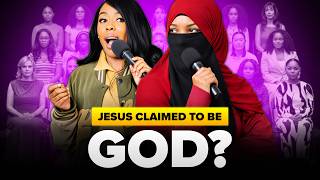 A structured walkthrough arguing that the case for Jesus's divinity rests on inference
 · Korra The Taymi ↗
0:54 ↗ She opens by asking for any evidence that Jesus preached his own deity or asked for worship, explicitly not requiring the exact words.
“So what evidence do we have to indicate that Jesus himself either preached to be God or preached that he should be receiving worship, and so on and so forth? Doesn't have to be verbatim.”
4:32 ↗ Against the argument from Jesus forgiving sins, she argues the Gospels present that authority as given to him by the Father, while one who possesses the divine essence would hold it inherently.
“Does Jesus inherently possess the authority to do anything, or does he gain that authority from the Father?”
6:01 ↗ She argues Son of Man is not a divine title: in Daniel 7 the son of man receives dominion and a kingdom from God, and God cannot coherently be given what He inherently has. She presses the same point against the two-natures reply her interlocutor offers.
9:24 ↗ On oneness with the Father, she cites John 17:20-23 and argues that the disciples there are to be one with the Father just as Jesus is, so the oneness is shared purpose, not shared essence.
“Jesus says that the disciples are one with the Father in the same exact way that he is one with the Father.”
10:55 ↗ She states her direct answer: in her reading, Jesus never makes an explicit claim to divinity, so the case for it has to be made by inference.
Continue at your pace
Questions people ask
Does the New Testament ever call Jesus God?
Yes. Raymond Brown's survey of the narrow question, where the New Testament applies the title theos to Jesus, found three clear instances (John 1:1, John 20:28, Hebrews 1:8-9) and several probable ones, while concluding there is “no reason to think that Jesus was called God in the earliest layers of New Testament tradition.” Brown himself warned that the title's absence from a book does not show its author denied Jesus's divinity, the title question and the larger question are distinct, and this page keeps them distinct.
What about “I and the Father are one” (John 10:30)?
Read the scene through verse 39, because its later verses matter on both sides. Accused of blasphemy, Jesus cites Psalm 82, “Isn't it written in your law, ‘I said, you are gods’?”, and restates his claim as “I am the Son of God”; then he returns to stronger language: “that you may know and believe that the Father is in me, and I in the Father.” The citation of a psalm where humans are called “gods” can be read as limiting the charge, or as an a-fortiori defense of a higher claim. The passage does not state Nicene consubstantiality; neither does it reduce cleanly to an ordinary human title. Both readings are on the page.
Doesn't “before Abraham came into existence, I AM” (John 8:58) claim the divine name?
The strongest Christian reading hears the absolute “I AM” as divine-name language echoing Exodus 3:14, and the crowd's move to stone him (8:59) shows they heard an enormous claim. Grant all of it, and it proves existence before Abraham, and pre-existence is not self-existence. John's own Word is with God, sent, and given glory: every verb receives. The saying also appears only in John, the latest Gospel, with no Synoptic parallel, a difference that may reflect development, genre, or selection, and the reader should weigh it with that location visible.
What did Jesus call God?
“My Father and your Father… my God and your God” (John 20:17); “the only true God” in distinction from himself (John 17:3); “the Lord our God, the Lord is one” when asked the greatest commandment (Mark 12:29, quoting the Shema); and the one he prayed to, “not what I desire, but what you desire” (Matthew 26:39). Christians read these within the incarnation; Islam reads them as the plain self-description of God's messenger. Which reading better explains the whole record is this page's question.
Scripture quotations link to a stable public-domain edition; scholarly attributions name their authors and sources. If a quotation or attribution is inaccurate, send a correction.