How to read the labels
- Consensusvirtually unanimous across critical scholarship (confessional scholars may differ, and where they do en bloc, the row's note says so).
- Majoritythe position most critical scholars hold, with a real dissenting minority.
- Genuinely disputedscholarship is actually split; the row leaves the split visible.
- Anonymousthe book's main text names no author (2 and 3 John identify their author only as “the elder”); the familiar name is an external attribution whose age is itself debated.
“Pseudepigraphal” means written under the name of someone who did not write it. Scholars differ on what to call that: Bart Ehrman argues the honest word is forgery; others hold that some ancient pseudonymous writing followed literary conventions its audience understood, though whether churches knowingly accepted falsely attributed apostolic letters is itself contested. Both framings appear in the sources linked below. Row sources are aggregate reference articles, linked and labeled as such: starting points that summarize the standard academic introductions, not the underlying scholarship itself. Treat each label as checkable, and check it.
The books
The Gospels and Acts
All five are internally anonymous. The familiar attributions are securely attested in the second century; scholars dispute how much earlier the names accompanied the texts.
Matthewtraditionally Matthew the apostle · ca. 80-90 CE
Anonymous (author unknown)
The large majority regards Matthew as a formally anonymous Greek composition, not an eyewitness work by the apostle Matthew. source ↗
Marktraditionally John Mark, companion/interpreter of Peter · ca. 65-75 CE, centered around 70 CE
Anonymous (author unknown)
The text is formally anonymous. Scholars still dispute (consensus has not disproved) whether its unknown author was nevertheless John Mark. source ↗
Luketraditionally Luke the physician, companion of Paul · ca. 80-90 CE
Anonymous (author unknown)
Luke and Acts are widely treated as one anonymous two-volume work. Scholars still genuinely debate identification with Paul's companion Luke. source ↗
Johntraditionally John the apostle, son of Zebedee · ca. 90-100 CE
Anonymous (author unknown)
The Gospel is internally anonymous, and most critical scholars reject direct composition by John the apostle. The beloved disciple may represent a source or authority behind it. source ↗
Actstraditionally Luke the physician, companion of Paul · ca. 80-90 CE
Anonymous (author unknown)
Scholars overwhelmingly attribute Acts and Luke to the same formally anonymous author, and still debate whether that author was Paul's companion Luke. source ↗
Paul's letters, the undisputed seven
Authorship rarely contested by any wing of scholarship.
Romanstraditionally Paul, with Tertius acting as scribe · ca. 55-58 CE, most often 56-57 CE
Consensus: traditional author
Romans belongs to the seven virtually undisputed Pauline letters. source ↗
1 Corinthianstraditionally Paul, with Sosthenes named as co-sender · ca. 53-57 CE, commonly 53-55 CE
Consensus: traditional author
The letter is virtually universally accepted as authentically Pauline. source ↗
2 Corinthianstraditionally Paul, with Timothy named as co-sender · ca. 55-56 CE
Consensus: traditional author
The material is accepted as authentically Pauline, although many scholars think the canonical book combines portions of multiple Pauline letters. source ↗
Galatianstraditionally Paul · ca. 48-55 CE
Consensus: traditional author
Galatians is one of the seven virtually undisputed Pauline letters. source ↗
Philippianstraditionally Paul, with Timothy named as co-sender · ca. 54-62 CE
Consensus: traditional author
Its material is accepted as authentically Pauline; scholars disagree over whether the canonical form is one letter or a compilation. source ↗
1 Thessalonianstraditionally Paul, Silvanus, and Timothy · ca. 49-51 CE
Consensus: traditional author
The letter is one of the seven virtually undisputed Pauline writings and is often considered the earliest surviving Christian text. source ↗
Philemontraditionally Paul, with Timothy named as co-sender · ca. 54-62 CE
Consensus: traditional author
Philemon is one of the seven virtually undisputed Pauline letters. source ↗
Paul's letters, the disputed six
Debated to varying degrees; most critical scholars regard Ephesians and the three Pastorals as written in Paul's name by later followers.
Ephesianstraditionally Paul · ca. 70-100 CE, often narrowed to 80-90 CE
Majority: not the traditional author
Most historical-critical introductions judge Ephesians post-Pauline, probably written by a follower developing Paul's thought. source ↗
Colossianstraditionally Paul, with Timothy named as co-sender · ca. 60-90 CE
Genuinely disputed
Critical scholarship is genuinely divided between Pauline authorship and composition by a close post-Pauline follower. source ↗
2 Thessalonianstraditionally Paul, Silvanus, and Timothy · ca. 51-52 CE if authentic; often late first century if pseudonymous
Genuinely disputed
Critical commentators remain genuinely divided over whether it is Pauline or a later pseudonymous response to 1 Thessalonians. source ↗
1 Timothytraditionally Paul · ca. 90-120 CE
Majority: not the traditional author
Most critical scholars regard 1 Timothy as post-Pauline and pseudonymous, written by an unknown follower or Pauline-school author. source ↗
2 Timothytraditionally Paul · ca. 90-140 CE
Majority: not the traditional author
The critical majority places 2 Timothy after Paul, though its personal details and testamentary form make it better defended as authentic than the other Pastorals. source ↗
Titustraditionally Paul · ca. 80-100 CE in many introductions
Majority: not the traditional author
Most historical-critical scholarship treats Titus with the Pastorals as a post-Pauline composition written in Paul's name. source ↗
Hebrews
Transmitted without an author's name; attributed to Paul only by later tradition.
Hebrewstraditionally Paul in influential later tradition, though ancient attributions varied from the start · ca. 60-95 CE
Anonymous (author unknown)
Hebrews is internally anonymous. Pauline authorship is overwhelmingly rejected, and no alternative author has achieved consensus. source ↗
The catholic epistles
A mix of disputed and near-consensus judgments.
Jamestraditionally James the brother of Jesus · ca. 70-100 CE for common pseudonymous dating
Genuinely disputed
A prevalent critical view regards James as pseudonymous, but authorship and dating remain sufficiently contested that a forced consensus label is misleading. source ↗
1 Petertraditionally Peter the apostle, possibly assisted by Silvanus · ca. 60-90 CE
Majority: not the traditional author
Most critical scholars regard 1 Peter as pseudepigraphic or the product of a Roman Petrine circle after Peter's death; direct Petrine authorship remains substantially defended, especially in evangelical and confessional scholarship. source ↗
2 Petertraditionally Peter the apostle · often early-to-mid second century; some datings reach the late first
Consensus: not the traditional author
Among critical scholars, 2 Peter is the clearest New Testament case of pseudepigraphy and is overwhelmingly judged not to have been written by Peter. source ↗
1 Johntraditionally John the apostle/evangelist · ca. 95-110 CE
Anonymous (author unknown)
The work is internally anonymous. Most critical scholars reject John the apostle, while often connecting it with the other Johannine epistles or a common literary circle. source ↗
2 Johntraditionally John the apostle/evangelist · ca. 90-110 CE
Anonymous (author unknown)
The author identifies himself only as 'the elder.' Most scholars do not equate him confidently with John the apostle, and his exact identity is unknown. source ↗
3 Johntraditionally John the apostle/evangelist · ca. 90-110 CE
Anonymous (author unknown)
The author calls himself 'the elder.' Common authorship with 2 John is strongly favored, but the elder's historical identity remains unknown. source ↗
Judetraditionally Jude/Judas, brother of James and Jesus; sometimes identified with the apostle Jude · ca. 70-100 CE
Genuinely disputed
The author claims to be Jude, brother of James, but scholarship remains divided over whether this is Jesus's historical brother, another Jude, or a pseudonymous attribution. source ↗
Revelation
Written by a John: the majority of critical scholars distinguish him from the son of Zebedee.
Revelationtraditionally John the apostle/evangelist · ca. 90-96 CE, usually about 95 CE
Majority: not the traditional author
The author explicitly names himself John and is conventionally called John of Patmos, but the majority separates him from both John the apostle and the Fourth Evangelist. source ↗
What this does and does not establish
It does not establish that the New Testament is worthless, or that its books teach nothing true. What it establishes is narrower: the four accounts of Jesus's life are internally anonymous, written in Greek (rather than the Aramaic Jesus ordinarily taught in) a generation or more after the events; the earliest surviving Christian writings include letters by Paul, who did not follow Jesus during his ministry (the Paul question, examined); and the traditional attributions of the anonymous books cannot simply be assumed. Anonymity is not proof of distance. Luke's preface claims investigation of what “eyewitnesses and servants of the word” delivered, and John 21 invokes a witness behind that Gospel. So the defensible conclusion is the calibrated one: most New Testament books cannot now be attributed to named eyewitnesses with scholarly consensus. Nearly all of this was established by Christian scholars, and the rows above link it so you can check it.
Why this matters to Muslims
Islam's claim about Jesus's message is structural: the Injil (the revelation given to Jesus) is, in the Quran's account, a scripture Jesus received, the way the Torah was given to Moses and the Quran to Muhammad ﷺ. What the New Testament contains is different in kind: Greek narratives about Jesus and the early church, letters, a homily-like work, and an apocalypse. Most of these, per the table above, cannot be securely tied to named eyewitness authors. That is the Quranic classification of the Injil; Christian theology uses “gospel” differently, for the proclamation and events concerning Jesus, and the contrast between those two categories is exactly what a reader should weigh. How each scripture was compiled and transmitted is its own study: how the Quran and the Bible each reached us.
The same question, argued on camera
The table above is this page's own record, and every row links its source. Two recordings follow, each embedded whole, in which a speaker makes the case out loud: a lecture from Blogging Theology, a channel presented by Paul Williams, on how scholars read the four Gospels, and a livestream published by EFDawah on the New Testament documents and their titles. The list under each video marks where the arguments we could verify begin, and the timestamps take you straight to them. Nothing quoted below is a speaker reading from a book: both speakers read other texts aloud at points, scripture in the lecture and scholars' books in the livestream, and none of those read passages is used here. These are voices answering the question, not authorities the table rests on. Where a speaker puts something more firmly than the sourced rows above do, the rows are the record.
Williams on the Gospels and their titles
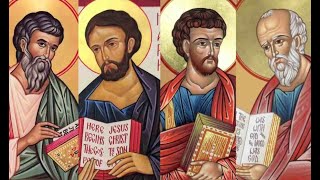 A solo lecture summarizing how mainstream critical scholarship dates the four Gospels and treats the names attached to them
 · Paul Williams (Blogging Theology) ↗
0:45 ↗ Williams opens his run through the mainstream dating with Matthew. He gives the date scholars propose, and points out that the book itself names nobody, whatever the title above it says.
“The first Gospel is the Gospel of Matthew. This was written, they say, around 80 to 85 AD. The author is unknown. I know it says the Gospel of Matthew, but in fact the Gospel doesn't claim to be by anyone in particular. No named individual is attached to the Gospel if you read the text itself.”
8:58 ↗ He then dates the four familiar names. The earliest record he knows of anyone attaching them to these books is late second century, in the church father Irenaeus.
“Well, the earliest historical record we have of anyone calling the four Gospels, which are anonymous, Matthew, Mark, Luke and John, is towards the end of the second century in the writings of an early church father called Irenaeus.”
10:14 ↗ His argument against apostolic authorship rests on language and schooling. The Gospels are polished Greek, and he holds that Galilean fishermen had neither the language nor the literacy for it, which is why he relays the scholars' verdict that the four are second-generation compositions rather than the work of first-generation eyewitnesses.
“They were written in sophisticated Greek, a language that your average fisherman from Galilee would not have been able to speak to that level. And they couldn't read and write anyway. They were peasants, basically. So it's virtually impossible that they could have written it themselves.”
EFDawah on when the names appear in the manuscripts
 A single-presenter livestream on the New Testament documents: who the traditional authors are said to be, and when the Gospel titles appear in the surviving copies
 · EFDawah ↗
0:47 ↗ The presenter starts with where the four names come from. In his account they reach us through church tradition rather than from the books, the information is late second century, and the names arrive in the manuscripts later still.
“Through church tradition we've been told that the Gospels were written by four historic individuals, Matthew, Mark, Luke and John. However, this information comes from the late second century, and we find that in the oldest and complete manuscripts of the New Testament that their names were added in much later.”
2:23 ↗ He sums up his own survey of the copies of Matthew, which he has published as a paper. On his reading the third-century copy carries no title at all, and in the fourth-century codex the name is added above a Gospel that had already been written out without one.
“So just to recap: third century, no title. Fourth century, you have Codex Sinaiticus already published and someone later coming to add the name of Matthew to it.”
6:13 ↗ His next point moves from authorship to the collection. Since Paul's letters came first, he argues, the earliest churches had no set of Gospels to appeal to, so believing in a New Testament was not asked of the first Christians.
“The earliest generations of Christians did not know of a New Testament and had no requirement to believe in it.”
Continue at your pace
- How the Quran and the Bible reached us
Both transmission histories, side by side, with the manuscript evidence for each, complications of both kept in.
- The Paul question
More New Testament books bear his name than any other author's, and he never followed Jesus during his ministry: the texts, the history, and the strongest case for each reading.
- Why did Jesus pray to God?
The study that started this series.
Questions people ask
Who wrote the four Gospels?
The Gospel texts themselves do not say, none of the four names its author in its main text. The explicit attributions to Matthew, Mark, Luke, and John are securely attested in the second century; scholars dispute how much earlier those names accompanied the texts. Critical scholarship regards none of the four as certainly the work of the person named in its title; church tradition defends the attributions, and the internal anonymity itself is acknowledged on all sides.
How many of Paul's letters did Paul actually write?
Of the thirteen letters bearing Paul's name, seven are virtually universally accepted in modern critical scholarship: Romans, 1 and 2 Corinthians, Galatians, Philippians, 1 Thessalonians, and Philemon. Colossians and 2 Thessalonians are genuinely debated, and most critical scholars regard Ephesians, 1 and 2 Timothy, and Titus as written in Paul's name by later followers.
Which New Testament book do scholars most doubt?
2 Peter. It faces the strongest critical consensus against traditional authorship of any New Testament book, most critical scholars have concluded that Peter did not write it, making it the standard example of New Testament pseudepigraphy. Many critical datings place it in the early or mid-second century, though proposed dates extend into the late first century.
Does any of this mean the New Testament is worthless?
No, and this page does not argue that. Anonymous authorship is not fraud, and even books scholars call pseudepigraphal are historical documents of early Christianity. What the scholarship establishes is narrower: most New Testament books cannot be securely attributed, by scholarly consensus, to named eyewitnesses of Jesus's ministry, and the traditional attributions of the anonymous books cannot simply be assumed. What follows from that is a question every reader, Christian or Muslim, has to weigh.
Each row links to its source. If a position is stated more confidently than the field warrants, or less, send a correction.