Representative passages, with links to their full chapters. The texts most often cited for Jesus's divinity have their own page; here is the material specific to threeness and oneness.
The triadic passages
Go and make disciples of all nations, baptizing them in the name of the Father and of the Son and of the Holy Spirit,
Matthew 28:19, WEB ↗ stands beside Paul's benediction: “The grace of the Lord Jesus Christ, God's love, and the fellowship of the Holy Spirit be with you all” (2 Corinthians 13:14). Naming the three together does not by itself establish co-equality. The Christian case joins these formulas to the titles, worship, and divine functions attributed to Son and Spirit elsewhere, and that fuller case is what the development test below weighs.
The one-God texts, and the dispute over them
yet to us there is one God, the Father, of whom are all things, and we for him; and one Lord, Jesus Christ, through whom are all things, and we live through him.
1 Corinthians 8:6, WEB ↗ is the verse both sides claim. Many Christian scholars hold that Paul is deliberately reworking the Shema, assigning “God” to the Father and “Lord” (the Greek rendering of the divine name) to Jesus, thereby including Jesus within the divine identity; others read the verse's plain apposition (“one God, the Father”) as ranking the two. The verse is evidence in the dispute, not a one-line settlement of it, and 1 Timothy 2:5 (“one God and one mediator between God and men, the man Christ Jesus”) belongs beside it.
Jesus, asked directly about oneness
Jesus answered, “The greatest is: ‘Hear, Israel, the Lord our God, the Lord is one.
Mark 12:29, WEB ↗ records the Shema of Deuteronomy 6:4, given as the greatest commandment; the scribe's restatement “there is none other but he” earns Jesus's praise in the same scene.
Nicaea, 325 CE, the Son
true God from true God, begotten not made, of one substance with the Father
Creed of Nicaea, 325 ↗ comes with its anathema attached: those who say the Son “came into existence out of nothing,” or is “of a different hypostasis or substance, or created… the Catholic and apostolic Church anathematizes.” The deciding word, homoousios (“of one substance”), is a term the council chose to exclude Arius's reading. It does not occur in scripture, which by itself decides nothing; the question is whether it preserves what the texts say or imports a new ontology, and that question is the development test below.
Constantinople, 381 CE, the Spirit
the Lord and Giver-of-Life, who proceeds from the Father, who with the Father and the Son together is worshipped and glorified
Niceno-Constantinopolitan Creed, 381 ↗ is the creed conventionally associated with the 381 council, and it makes the Spirit's shared worship explicit, fifty-six years after Nicaea. The fourth century established the broadly Nicene framework; terminology and implications continued to be worked out after it.
How reference scholarship summarizes it
The New Testament contains no explicit trinitarian doctrine. However, many Christian theologians, apologists, and philosophers hold that the doctrine can be inferred from what the New Testament does teach about God.
Stanford Encyclopedia of Philosophy, “History of Trinitarian Doctrines” ↗: both sentences are quoted here because both are the field's summary. Britannica's Trinity article: “Neither the word ‘Trinity’ nor the explicit doctrine appears in the New Testament,” and “The doctrine developed gradually over several centuries and through many controversies” (Britannica ↗). These are general academic reference works, not Muslim polemics.
The most explicit proof-text, and its history
For there are three that bear record in heaven, the Father, the Word, and the Holy Ghost: and these three are one.
1 John 5:7, King James Version, is the Comma Johanneum. Text-critical scholarship is essentially unanimous that this sentence is a late addition: in the NET Bible's textual note, “the evidence, both external and internal, is decidedly against its authenticity,” and the longer reading “is found only in nine late mss, four of which have the words in a marginal note,” having entered from the Latin tradition (NET tc note ↗). Modern scholarly translations omit it. You can check the fourth-century text yourself: 1 John 5 in Codex Sinaiticus ↗.
Grant the Christian case its full form first. The church inherited data it refused to surrender: the Shema's one God; worship already given to the risen Christ early, as the Philippians hymn shows; the Spirit spoken of in personal terms; and, its scholars add, Paul's possible reworking of the Shema itself around “one God” and “one Lord.” On this account Nicaea invented nothing. It paid for holding everything at once: non-biblical vocabulary spent to keep biblical content from Arius's reading. Newman called it development. And vocabulary absence cannot defeat it: a later technical term may faithfully summarize an earlier truth.
Now test it. A development claim is a claim about fit, and fit can be checked. Take four representative sentences on God's oneness, quoted above. “Hear, Israel, the Lord our God, the Lord is one.” “One God, the Father, of whom are all things.” “The only true God, and Jesus Christ whom you sent.” “My God and your God.” On one model these cohere as written: one God, and His exalted messenger. On the Nicene model each carries a qualification: “the Father” names a person rather than the Godhead; the Shema means one essence rather than one person. For 1 Corinthians 8:6 the tradition's scholars answer with a stronger move, engaged above: that Paul is placing Jesus inside the Shema, not beside it. The qualifications are coherent. They are also costs. But the rival model pays a price of its own: on that reading, the prologue's “was God,” Thomas's address, and Hebrews's creator-psalm all have to be taken as agency-language and acclamation stretched to their limit (each is examined here). Which set of costs runs higher is the whole question, and it is a real one, not rhetorical.
When Arius denied the Son's full deity, why could no sentence of scripture settle it? Why did the answer require a council, and a word, homoousios, that scripture never uses?
One more measurement before the answer. Prayer in the New Testament runs predominantly to the Father. Invocations of Jesus exist: Stephen's “Lord Jesus, receive my spirit” (Acts 7:59), “come, Lord Jesus” (Revelation 22:20), the Aramaic Maranatha. They are real data for the Christian side. No unambiguous recorded prayer addresses the Spirit. The predominance of prayer to the Father is the pattern a strict monotheism would predict, while the invocations of Jesus remain evidence that model must explain.
Now count what the test produced: both columns. The oneness sentences read as written on one model and carry qualifications on the other; the prayer pattern fits strict monotheism, with the invocations of Jesus as the data it must explain; and the doctrine's full form required a definition, framed against live Christian readings (Arius's among them, held by bishops) that placed the Son on the creature's side of the line. The creed's column holds the strongest divine-language texts, the early worship, and coherent answers to each point above: role order is compatible with equality of nature; the summary statements were never meant as metaphysical exclusions; definition is what development looks like under pressure. Weigh the two columns yourself; the documents are all linked above. What the history itself settles is narrower, and it is this page's one hard fact: no sentence of scripture settled the dispute. The church drew its boundary by conciliar definition, and the fight ran on for another half-century. Development or addition: that is the question Nicaea leaves you. Islam answers it in a sentence: “Allah is only One God. Glory be to Him! He is far above having a son” (Quran 4:171 ↗).
What this page is not claiming
It is not claiming the councils were cynical, or that the bishops did not believe what they defined, or that Christian worship of Christ was a fourth-century novelty; the evidence is against all three. Many churches regard the Nicene doctrine as a boundary of orthodoxy; this page asks a narrower question: how explicitly scripture states the doctrine, and how far Christians had to interpret the texts to reach it. You can now weigh that with the documents in front of you.
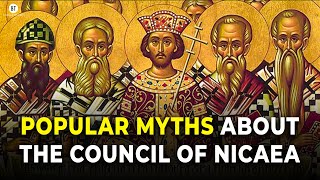
The documents above are this page's material. Two recordings follow, embedded whole. Timestamps jump to each argument. Both are from Blogging Theology, a channel presented by Paul Williams. In the first, Williams corrects common myths about the Council of Nicaea, including one error he says is perpetuated by some Muslim scholars. In the second, he reads, by his own on-camera statement, from the writings of William Ellery Channing, a nineteenth-century American preacher who argued the doctrine is nowhere stated in the New Testament; the words in its quotes are Channing's, read and endorsed by Williams.
Is the Trinity in the Bible?
Not as a formulation, three co-equal, co-eternal persons in one essence is stated by the fourth-century creeds, not by any biblical sentence, a point general reference scholarship confirms: “The New Testament contains no explicit trinitarian doctrine” (Stanford Encyclopedia of Philosophy). What the New Testament contains is data pulling in both directions: triadic passages naming Father, Son, and Spirit together (Matthew 28:19); the highest statements about Jesus, examined on their own page; and texts like “to us there is one God, the Father… and one Lord, Jesus Christ” (1 Corinthians 8:6) and “the only true God, and him whom you sent” (John 17:3). Whether the creeds develop that data or add to it is this page's question.
Did the Council of Nicaea invent Christianity or the Bible?
No, and pages that claim it did are wrong, whichever direction they argue. Nicaea (325 CE) did not write or select the Bible; the biblical books were already circulating, and canon recognition proceeded through other local and ecclesial processes over a long period. What Nicaea did is specific and documented: it answered Arius by defining the Son as “of one substance with the Father” and anathematized those who said the Son “came into existence out of nothing.” The creed conventionally associated with the Council of Constantinople (381) expands the confession of the Holy Spirit. Those are the facts this page builds on, no more.
What about 1 John 5:7, “the Father, the Word, and the Holy Ghost: and these three are one”?
That wording, the Comma Johanneum, printed in the King James Version, is the most explicit triadic-unity proof-text traditionally cited from the New Testament, and text-critical scholarship is essentially unanimous that it is a late addition: in the NET Bible's textual note, “the evidence, both external and internal, is decidedly against its authenticity”; it is absent from the early Greek manuscripts and entered the tradition from Latin copies centuries later. Modern scholarly translations (NRSV, ESV, NIV, NET) omit it from the text. Its absence does not settle the Trinity question by itself; it does mean the tradition's most explicit proof-text was added by later hands.
What did Jesus say when asked about God's oneness?
Asked the greatest commandment, he answered with Israel's confession: “Hear, Israel, the Lord our God, the Lord is one” (Mark 12:29, quoting Deuteronomy 6:4). The scribe restates it, “he is one, and there is none other but he”, and Jesus tells him he is “not far from God's Kingdom.” Trinitarians note that their doctrine claims to be monotheism and would not expect Jesus to amend the Shema; the observation that remains is that when the question of God's identity was put to him directly, the recorded answer was Israel's, unglossed. Islam's declaration of faith begins in the same place, and the Quran addresses Christians on this exact point: “say nothing about Allah except the truth… do not say, “Trinity.” Stop!, for your own good. Allah is only One God” (Quran 4:171).
Scripture quotations are World English Bible unless a translation is named; creed texts link to their editions. If a quotation or attribution is inaccurate, send a correction.