What the Quran says about him, in its own words
Renderings are Dr. Mustafa Khattab's The Clear Quran, the default translation on quran.com; each links to the verse so you can read the surrounding passage.
The annunciation
˹Remember˺ when the angels proclaimed, “O Mary! Allah gives you good news of a Word from Him, his name will be the Messiah, Jesus, son of Mary; honoured in this world and the Hereafter, and he will be one of those nearest ˹to Allah˺.
Quran 3:45 ↗
The virgin birth
Mary wondered, “My Lord! How can I have a child when no man has ever touched me?” An angel replied, “So will it be. Allah creates what He wills. When He decrees a matter, He simply tells it, ‘Be!’ And it is!
Quran 3:47 ↗
The miracles, with their signature
‘I have come to you with a sign from your Lord: I will make for you a bird from clay, breathe into it, and it will become a ˹real˺ bird, by Allah's Will. I will heal the blind and the leper and raise the dead to life, by Allah's Will.
Quran 3:49 ↗: the repeated phrase marks the miracles as real while attributing their efficacy to God's permission.
His own words in the cradle
Jesus declared, “I am truly a servant of Allah. He has destined me to be given the Scripture and to be a prophet.
Quran 19:30 ↗: this verse comes from the chapter named for Mary, the only woman named in the Quran.
The comparison the Quran itself draws
Indeed, the example of Jesus in the sight of Allah is like that of Adam. He created him from dust, then said to him, “Be!” And he was!
Quran 3:59 ↗: the verse compares Jesus's fatherless creation with Adam's. Muslim interpreters commonly cite the comparison against treating the virgin birth by itself as proof of deity.
The boundary
O People of the Book! Do not go to extremes regarding your faith; say nothing about Allah except the truth. The Messiah, Jesus, son of Mary, was no more than a messenger of Allah and the fulfilment of His Word through Mary and a spirit ˹created by a command˺ from Him.
Quran 4:171 ↗: “created by a command” is Khattab's bracketed interpretive gloss; the Arabic reads “a spirit from Him.” Classical Muslim exegesis understands that phrase in a created, non-divine sense.
Central affirmations and denials
- Affirmed: Jesus is the Messiah, al-Masih occurs eleven times across nine Quranic verses and is applied to no one else (Quranic Arabic Corpus ↗); born of the virgin Mary; strengthened with the holy spirit (5:110); worker of real miracles (healing, raising the dead) by God's permission; given a revelation, the Injil; “honoured in this world and the Hereafter” and “one of those nearest” to God (3:45); raised by God to Himself (4:158). Love and reverence for Jesus are not a concession in Islam; they are an obligation.
- Denied: that Jesus is God; that he is the son of God; that God is a Trinity of which he is one person (4:171); that his enemies succeeded in killing or crucifying him, on the dominant Islamic reading: “They certainly did not kill him” (4:157; the crucifixion question, examined in full).
- Held with its sources named: his return before the end of history, mainstream doctrine, explicit in hadith; Muslim exegetes have often, though not unanimously, read 4:159 and 43:61 in support, and the Quran does not narrate a return in explicit terms.
Why the line sits exactly there
The ledger above follows from one principle applied without exception: the Creator is independent of all things, and everything created is dependent, so Islam refuses to apply both descriptions to one object of worship. Every honor Islam gives Jesus sits on the creation side of that line: chosen, strengthened, given scripture, granted miracles by God's Will. Every denial guards the other side. Christians answer through the distinction between Christ's divine and human natures; the flagship study engages that answer on its own premises; this primer only states where each side stands. The Quran states the principle as God's own self-description: “Allah, the Sustainer ˹needed by all˺. He has never had offspring, nor was He born” (Quran 112:2-3 ↗).
In Islam, honoring Jesus and refusing to worship him are not in tension: the messenger receives everything that belongs to a messenger, and God everything that belongs to God.
And in the Quran's account, the Messiah's own words draw the line: “Worship Allah, my Lord and your Lord” (Quran 5:72 ↗). That formulation runs close to John's Gospel: “I am ascending to my Father and your Father, to my God and your God” (John 20:17, WEB). These are parallel formulations each tradition places on Jesus's lips, not two transcripts of one utterance. How each tradition locates such words within its larger account of Jesus is part of the disagreement, and the studies below put the relevant texts in front of you.
Where this primer sits in the series
The same picture, argued on camera
The written primer above stands on its own. Two recordings follow, embedded whole. The first is a talk given at Oxford by Paul Williams, who presents the channel Blogging Theology, on how the Quran describes Jesus and where that description parts from the church's. The second is a short study from the channel Towards Eternity, which sets Quranic and biblical passages about Jesus side by side. Timestamps jump to each argument.
Williams is introduced by a host at the start and takes audience questions at the end, and he reads several authors aloud during the talk. Every quote below comes from a stretch where he speaks alone and for himself, between two of those readings. The Towards Eternity video is narrated by one person who is never named on camera, so the channel is credited and no author is claimed. These are voices answering the question, not authorities this page rests on.
Paul Williams on the Jesus the Quran describes
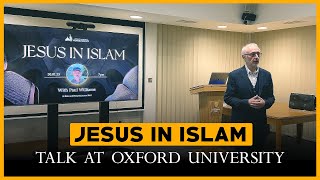 A university talk on how the Quran describes Jesus, and on the earliest beliefs about him
 · Paul Williams (Blogging Theology) ↗
34:44 ↗ Williams sets the Quran's Jesus beside what he says the earliest Jewish followers of Jesus believed. In the Quran, on his reading, Jesus is a prophet sent by God who works miracles by God's permission, who is the Messiah, and who is born of the virgin Mary.
“He does miracles by God's permission. He is the Messiah. And he's born of the Virgin Mary.”
35:47 ↗ Williams argues that Jesus is more at home in Islam than in Christianity. His reason is about Jesus rather than about Christians: raising Jesus to a status equal to God's is not, Williams says, what Jesus himself would have wanted.
“Because what they have done to him is not what he would have liked. I think he would have been at best horrified at what has happened to him. The way people have elevated him to an absolute status equal to that of God himself.”
36:20 ↗ The saying Williams has just cited is Jesus asking why he is called good and answering that no one is good but God alone. Williams applies a test historians use on sayings attributed to Jesus: a saying that works against the beliefs of the people who wrote it down is unlikely to have been invented by them, so he treats this one as early and authentic.
“Why would the church of the 60s, 70s and 80s have invented a saying like that, which is so contrary to the beliefs of the second generation Christians who produce the Gospels? Why would they credit Jesus for statements which are clearly against their own creed?”
Towards Eternity on the Quran and the Gospels side by side
 A narrated study comparing what the Quran and the Bible say about Jesus, passage by passage
 · Towards Eternity ↗
2:53 ↗ The narrator argues that the virgin birth shows God's power rather than Jesus's divinity, and points to the comparison the Quran itself draws: God created Adam with neither father nor mother.
“This is how the good news of Jesus was given. Almighty God decreed that he would be born without a father. It was very easy for Allah to do that: just as He had created the first human prophet Adam without a father and without a mother, He would also create Jesus without a father.”
9:46 ↗ The narrator has just read the scribe's exchange with Jesus from the Gospel of Mark, where Jesus answers that the first commandment opens “the Lord our God, the Lord is one.” The narrator then sets a Quranic verse beside those words, in which Jesus tells his people that God is his Lord and theirs.
“Similarly, in the Quran, Jesus told his nation a shared truth: ‘Indeed, Allah is my Lord and your Lord, so worship Him alone. This is a straight path.’”
19:20 ↗ Late in the video, the narrator runs a swap test: replace the titles God and son of God with prophet and messenger, and, the narrator claims, what looked confusing in the story reads plainly.
“Don't you think that the story told by Islam gives us a more accurate picture of Jesus? In many parts of the story, when we replace titles used for Jesus like God and son of God with prophet and messenger, the confusion disappears.”
Continue at your pace
- Did Jesus say he is God?
The central Christian texts, quoted with their context and answered one by one.
- Was Jesus crucified?
Where Islam and the historians genuinely disagree, with the evidence's real shape stated.
- Speak with someone nearby
Find a mosque in your city through the verified directory, and bring these questions to people who have lived with them.
Questions people ask
Do Muslims believe in Jesus?
Yes, belief in Jesus is an article of Islamic faith, not an option. The Quran calls him the Messiah, born of the virgin Mary, strengthened with the holy spirit, a worker of miracles by God's permission, a messenger, and one of those brought near to God. Muslim faith requires affirming him: denying Jesus would contradict the Quran's required belief in God's messengers. What Islam denies is narrower: that Jesus is God, the son of God, or one person of a triune God.
Do Muslims believe in the virgin birth?
Yes. The Quran narrates the annunciation to Mary directly: “My Lord! How can I have a child when no man has ever touched me?” An angel replied, “So will it be. Allah creates what He wills” (Quran 3:47). The Quran compares the creation of Jesus without a father to the creation of Adam: “the example of Jesus in the sight of Allah is like that of Adam. He created him from dust, then said to him, ‘Be!’ And he was!” (3:59). Mary is the only woman named in the Quran, and its nineteenth chapter is named for her.
Will Jesus return, according to Islam?
Mainstream Sunni and Shi'i teaching holds that Jesus was taken up alive and will return before the end of history. The return is explicit in hadith, recorded statements of the Prophet Muhammad ﷺ; Quran 4:158 says God raised Jesus to Himself, and Muslim exegetes have often, though not unanimously, read 4:159 and 43:61 in support, 4:159's pronouns are ambiguous, and the Quran does not narrate a return in explicit terms. The sources differ in kind, and the difference is worth knowing.
Why don't Muslims worship Jesus?
Because, in the Quran's account, the Messiah's own words direct worship to God: “Worship Allah, my Lord and your Lord” (Quran 5:72). The principle underneath is that worship belongs to the Creator, who depends on nothing, and not to any creature, which is why honoring Jesus as a messenger is commanded in Islam and worshipping him is not. Christians locate Jesus on the other side of that line through the doctrine of the incarnation; the argument pages of this series engage that position directly.
Quran renderings are Dr. Mustafa Khattab's The Clear Quran, linked verse by verse; Bible quotations are World English Bible. If a quotation or attribution is inaccurate, send a correction.